Market Navigator — Week of November 10, 2025
Market Navigator—Week of November 10, 2025
Presented by Zachary R. Sturdy
---
U.S. equities declined after three consecutive weeks of gains. The sell-off was led by weakness from big technology firms. AI spending and the returns companies could earn on that investment continued to come under scrutiny. ADP reported employment gains for October, but consumer confidence continued to deteriorate on concerns about the government shutdown.
Quick Hits
1. Beyond the headlines: Index concentration cuts both ways.
2. Report releases: Economic reports continued to show a mixed bag.
3. Financial market data: Equity markets declined on weakness from big technology stocks. Treasuries were firmer on weakening consumer sentiment.
4. Looking ahead: We expect weekly state-level jobless claims and several speeches from Federal Reserve (Fed) members.
Keep reading for an in-depth look.
Beyond the Headlines: Index Concentration Cuts Both Ways
The top 10 companies in the S&P 500 account for almost 40 percent of the index, an all-time high. (The so-called Magnificent Seven, including two different share classes of Alphabet, are included.) Broadcom and Berkshire Hathaway round out the top 10. The technology sector makes up more than 35 percent of the S&P 500. For better or worse, these stocks and this sector are perceived to be the market by many because they drive the daily moves of the S&P 500. Over the past few years, investors have benefited from this concentration; Magnificent Seven companies were the only area of the market that showed earnings growth, and the appreciation of these stocks drove markets higher. The same effect can occur on the way down, however.
Tough Week for Tech Sector
Against that backdrop, the technology-heavy Nasdaq Composite declined more than 3 percent. In its worst week since April, the technology sector dipped more than 4 percent. Continued scrutiny about AI spending and the ability for the companies doing so to earn a return continued to weigh on this part of the market. In turn, weakness in the technology sector caused the S&P 500 to decline 1.63 percent.
Those headline declines led many news reports over the weekend. Despite the importance of technology to the U.S. economy and the markets, other areas that make up a balanced portfolio can be influenced by factors that have nothing to do with technology spending. Last week, the equally weighted S&P 500 (an index that gives each of the 500 stocks the same weight, as opposed to the traditional market capitalization index that favors bigger companies) was basically flat, declining just 0.19 percent. In fact, 7 of the 11 GICS sectors had positive returns, led by energy, health care, real estate, and financials.
Strong Earnings Growth
In large part, this was driven by strong earnings growth from reporting companies. Eighty-two percent of S&P 500 companies that have reported earnings so far have beat analyst expectations. Third-quarter earnings growth is expected to be 13.1 percent. Just one week ago, the expectation was that third-quarter earnings growth would be 10.7 percent, which illustrates just how strong the reports were. At the end of September, however, that number was just 7.9 percent. This will mark four consecutive quarters with double-digit earnings growth. In addition, it isn’t narrow earnings growth, as we have seen in recent years. This quarter, 8 of 11 sectors have reported earnings above analyst expectations. That is a testament to the resilience of corporate America in the face of several economic headwinds over the past year.
Diversification fell out of favor when a small group of companies driven by the same theme were providing the bulk of the market returns; however, that hasn’t necessarily been the case at various points this year. We expect this trend to continue and that broad earnings growth will be supportive of the broad market over the intermediate term.
Report Releases—November 3–7, 2025
Institute for Supply Management (ISM) Manufacturing Index: October (Wednesday)
Manufacturing activity slowed more than expected as new orders and hiring continued to contract.
· Expected/prior month ISM Manufacturing index: 49.5/49.1
· Actual ISM Manufacturing index: 48.7
ADP Employment Report: October (Wednesday)
Roughly 42,000 private jobs were added last month, slightly better than the 30,000 that were anticipated.
- Expected/prior month private jobs added: +30,000/–29,000
- Actual private jobs added: +42,000
ISM Services Index: October (Wednesday)
Service sector activity rebounded, supported by a rise in new orders during the month.
- Expected/prior month ISM Services index: 50.8/50
- Actual ISM Services index: 52.4
University of Michigan Consumer Sentiment Survey: November (Friday)
Consumer sentiment continued to erode on concerns about the economic impact of a prolonged government shutdown.
- Expected/prior month University of Michigan consumer sentiment survey: 53.0/53.6
- Actual University of Michigan consumer sentiment survey: 50.3
The Takeaway
· ISM surveys showed that manufacturing continued to deteriorate while services rebounded.
· The ADP report showed an improvement in employment last month, with the 42,000 new jobs created exceeding expectations. (Without government employment data to confirm the trend, it appears that the job market continues to be sluggish but is not yet contracting.)
· Consumer confidence continued to deteriorate. The University of Michigan consumer sentiment survey was close to its all-time low from June 2022.
Financial Market Data
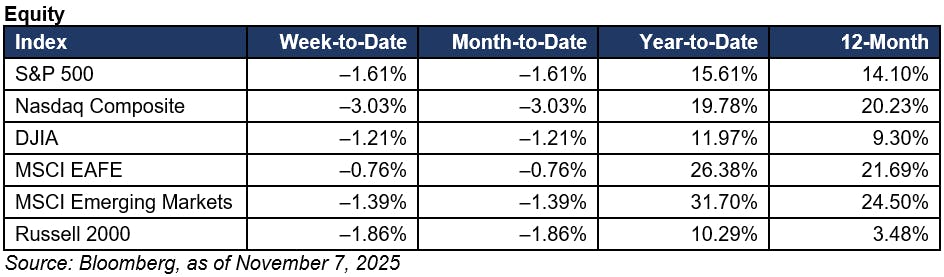
The Nasdaq led markets lower after three consecutive weeks of gains, with all major indices declining. Big technology was the worst performing part of the market. The equal-weight S&P 500 was basically flat, showing underlying strength. AI scrutiny caused weakness in technology, including semiconductors and software. Strength was seen in banks, energy, health care, financials, consumer staples, and utilities.
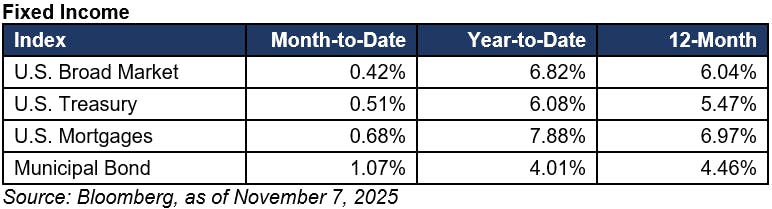
Treasuries were mostly firmer as the yield curve steepened slightly. Weakening consumer confidence drove sentiment in the Treasury market. Other parts of the bond market were flat or down.
The Takeaway
· Equities declined after three consecutive weeks of gains. Technology led the market lower on continued AI scrutiny. The equal-weight S&P 500 was virtually flat, indicating strength outside the technology sector.
· Treasuries were firmer as yields dropped slightly. Investors reacted to non-government data that showed the potential for economic weakness, particularly in layoffs and consumer sentiment, as the government shutdown continued.
Looking Ahead
This week is anticipated to be light because of the government shutdown. The focus will be on speeches from several Fed officials throughout the week as well as state-level jobless claims.
· Assuming economic data from the government remains on hold, it will be a quiet week for macro reports. On Wednesday, we expect state-level jobless claims to be reported.
· Third-quarter earnings will wind down, with key reports from Applied Materials, Cisco, Occidental Petroleum, and Tyson Foods.
Disclosures: This material is intended for informational/educational purposes only and should not be construed as investment advice, a solicitation, or a recommendation to buy or sell any security or investment product. Diversification does not assure a profit or protect against loss in declining markets, and diversification cannot guarantee that any objective or goal will be achieved. Please contact your financial professional for more information specific to your situation.
Bonds are subject to availability and market conditions; some have call features that may affect income. Bond prices and yields are inversely related: when the price goes up, the yield goes down, and vice versa. Market risk is a consideration if sold or redeemed prior to maturity.
Certain sections of this commentary contain forward-looking statements that are based on our reasonable expectations, estimates, projections, and assumptions. Forward-looking statements are not guarantees of future performance and involve certain risks and uncertainties, which are difficult to predict. All indices are unmanaged and are not available for direct investment by the public. Past performance is not indicative of future results. The S&P 500 is based on the average performance of the 500 industrial stocks monitored by Standard & Poor’s. The Nasdaq Composite Index measures the performance of all issues listed in the Nasdaq Stock Market, except for rights, warrants, units, and convertible debentures. The Dow Jones Industrial Average is computed by summing the prices of the stocks of 30 large companies and then dividing that total by an adjusted value, one which has been adjusted over the years to account for the effects of stock splits on the prices of the 30 companies. Dividends are reinvested to reflect the actual performance of the underlying securities. The MSCI EAFE Index is a float-adjusted market capitalization index designed to measure developed market equity performance, excluding the U.S. and Canada. The MSCI Emerging Markets Index is a market capitalization-weighted index composed of companies representative of the market structure of 26 emerging market countries in Europe, Latin America, and the Pacific Basin. The Russell 2000® Index measures the performance of the 2,000 smallest companies in the Russell 3000® Index. The Bloomberg US Aggregate Bond Index is an unmanaged market value-weighted performance benchmark for investment-grade fixed-rate debt issues, including government, corporate, asset-backed, and mortgage-backed securities with maturities of at least one year. The U.S. Treasury Index is based on the auctions of U.S. Treasury bills, or on the U.S. Treasury’s daily yield curve. The Bloomberg US Mortgage Backed Securities (MBS) Index is an unmanaged market value-weighted index of 15- and 30-year fixed-rate securities backed by mortgage pools of the Government National Mortgage Association (GNMA), Federal National Mortgage Association (Fannie Mae), and the Federal Home Loan Mortgage Corporation (FHLMC), and balloon mortgages with fixed-rate coupons. The Bloomberg US Municipal Index includes investment-grade, tax-exempt, and fixed-rate bonds with long-term maturities (greater than 2 years) selected from issues larger than $50 million. One basis point is equal to 1/100th of 1 percent, or 0.01 percent. One basis point (bp) is equal to 1/100th of 1 percent, or 0.01 percent.
###
Zachary Sturdy is located at 307 S Front St, Ste 107 Marquette, MI 49855 and can be reached at (906)226-6056. Securities and advisory services offered through Commonwealth Financial Network®, Member FINRA/SIPC, a Registered Investment Adviser. Fixed insurance products and services are separate from and not offered through Commonwealth Financial Network®.
Authored by the Investment Research team at Commonwealth Financial Network®.
© 2025 Commonwealth Financial Network®