Market Navigator—Week of August 18, 2025
Market Navigator—Week of August 18, 2025
Presented by Zachary R. Sturdy
---
U.S. equities advanced as small-caps and retail favorites outperformed. Defensive sectors such as utilities, REITs, and grocers lagged. Treasuries firmed at the long end of the yield curve, the dollar softened, and strong conviction in a Federal Reserve (Fed) interest rate cut next month kept
sentiment positive.
Quick Hits
1. Beyond the headlines: Elevated valuations and shifting Fed pressures could shape market volatility.
2. Report releases: Producer prices rose at their fastest rate in more than three years last month.
3. Financial market data: Retail favorites, cyclicals, and M&A strength lifted equities as rate cut expectations supported sentiment.
4. Looking ahead: The focus this week will be on housing indicators, Fed policy signals, and existing home sales.
Beyond the Headlines: Elevated Valuations and Shifting Fed Pressures Could Shape Market Volatility
Equity valuations remain elevated across most regions and sectors, a reminder that despite strong earnings growth supporting markets this year, pricing has little room for disappointment. The forward price-to-earnings (P/E) ratio of the S&P 500 sits above its 10-year average, with growth-oriented areas such as the Russell 1000 Growth Index and information technology stocks commanding particularly rich multiples. Even international markets, which historically trade at discounts, show valuations near or above their averages. Against this backdrop, volatility risk is rising—not necessarily because elevated valuations signal an imminent sell-off, but because they magnify the market’s sensitivity to surprises.
Recent Economic Data Heightens Unpredictability
The latest economic data has only added to this potential. A stronger-than-expected Producer Price Index report raised questions about the durability of disinflation trends, heightening pressure on the Fed to deliver rate cuts this year. Compounding the uncertainty, the recent removal of the commissioner of the Bureau of Labor Statistics has drawn investor scrutiny over the reliability of official data. Together, these developments have fueled debate around whether incoming data reflects a genuine slowdown or statistical noise—an ambiguity that could amplify swings in market sentiment.
Valuation dispersion underscores the challenge. On one hand, sectors such as energy and materials are trading near long-term lows on forward multiples, reflecting subdued earnings expectations. Conversely, richly valued sectors such as technology and consumer discretionary remain priced for continued growth. Corporate earnings trends provide partial justification; recent reports show double-digit gains
for technology and communication services, whereas cyclical sectors face more muted—or even negative—revisions. With expectations already high in growth-heavy sectors, any signs of margin compression or slowing demand could trigger outsized reactions.
Unusual Treasury Yield Curve
Meanwhile, the Treasury yield curve has taken a U shape—short rates have fallen in anticipation of Fed easing while longer yields remain anchored by heavy Treasury supply and inflation risks. This unusual shape reflects investor uncertainty about the balance between easing financial conditions and potential tariff-driven inflation. Despite the noise, volatility measures remain subdued; the CBOE Volatility Index (VIX) sits at low levels, suggesting markets are either overly confident in Fed support or are underestimating the risks of a policy misstep.
For investors, this environment argues for balance. Elevated valuations alone are not a reason to reduce exposure wholesale because markets can sustain higher multiples when supported by earnings growth and easier financial conditions; however, they do warrant greater selectivity and risk management.
Rate-sensitive sectors could benefit from easing policy, but cyclical areas may struggle if growth slows further. A diversified allocation across styles, sectors, and geographies can help buffer against unexpected shocks. Maintaining flexibility, avoiding concentration in the most richly priced areas, and staying attentive to incoming data will be critical as markets navigate the coming months.
Report Releases—August 11–15, 2025
Consumer Price Index (CPI): July (Tuesday)
Headline consumer price growth was slightly below economist estimates last month. Core producer prices rose more than expected.
- Prior monthly CPI/core CPI growth: +0.3%/+0.2%
- Expected monthly CPI/core CPI growth: +0.2%/+0.3%
- Actual monthly CPI/core CPI growth: +0.2%/+0.3%
- Prior year-over-year CPI/core CPI growth: +2.7%/+2.9%
- Expected year-over-year CPI/core CPI growth: +2.8%/+3.0%
- Actual year-over-year CPI/core CPI growth: +2.7%/+3.1%
Producer Price Index (PPI): July (Wednesday)
Producer inflation surged past economist estimates; the 0.9 percent rise in prices last month was the largest increase in more than three years.
- Prior monthly PPI/core PPI growth: +0.0%/+0.0%
- Expected monthly PPI/core PPI growth: +0.2%/+0.2%
- Actual monthly PPI/core PPI growth: +0.9%/+0.9%
- Prior year-over-year PPI/core PPI growth: +2.4%/+2.6%
- Expected year-over-year PPI/core PPI growth: +2.5%/+3.0%
- Actual year-over-year PPI/core PPI growth: +3.3%/+3.7%
Retail Sales: July (Friday)
Retail sales remained strong, marking two consecutive months with solid sales growth after a surprising decline in May.
- Expected/prior month retail sales monthly change: +0.6%/+0.9%
- Actual retail sales monthly change: +0.5%
University of Michigan Consumer Sentiment Survey: August (Thursday)
Consumer sentiment slipped about 5 percent, breaking a four-month streak of gains, as inflation worries and weaker buying conditions weighed on confidence.
- Expected/prior month consumer sentiment index: 62.5/61.8
- Actual consumer sentiment index: 58.6
The Takeaway
· The July CPI report held steady at 2.7 percent and core growth rose to 3.1 percent; producer prices climbed 0.9 percent, the strongest monthly gain in more than three years.
· Retail sales advanced for a second consecutive month, but consumer sentiment fell 5 percent as inflation concerns weighed on household confidence.
Financial Market Data
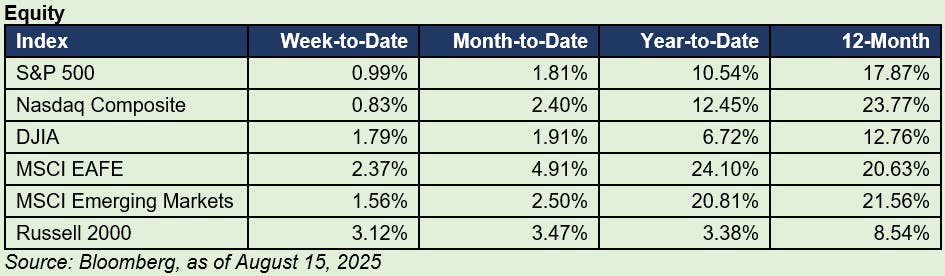
Equities gained broadly, displaying strength in retail favorites and heavily shorted names, along with solid performance in managed care, media, airlines, home builders, and credit cards. Defensive sectors such as staples, utilities, and REITs lagged. Semiconductor capital equipment underperformed. Although corporate news and M&A activity added to momentum in select areas, it was offset by weakness in grocery retailers, restaurants, and some technology companies. Overall sentiment was supported by expectations for interest rate cuts, and earnings season continued to deliver mostly positive surprises despite cautious guidance. Trade headlines and inflation concerns added volatility, but the broader equity tone remained constructive heading into the Fed’s next meeting in September.
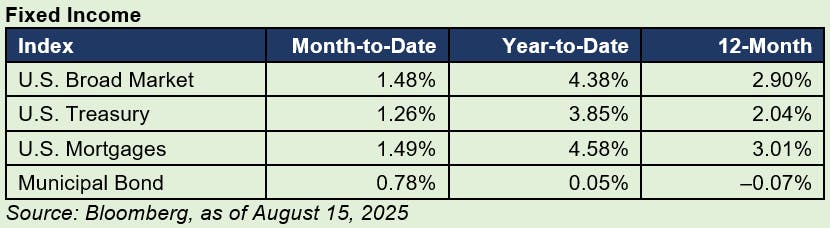
Treasuries were steady to slightly firmer, with long-end yields easing as the gap between 2- and 10-year yields steepened to its widest since May. Market expectations for a September rate cut remained high, though a hotter-than-expected PPI report and firmer inflation expectations tempered the rally. The central bank remained cautious, with officials downplaying the need for a 50 basis point (bps) cut but affirming a path toward lower rates. Treasury Secretary Scott Bessent floated—then walked back—the idea of a larger cut in September, keeping the focus on Fed Chair Jerome Powell’s upcoming remarks. Credit markets were stable; spreads held firm despite mixed economic signals and persistent uncertainty around tariffs and growth.
The Takeaway
· Equities advanced on strength in retail favorites, managed care, media, airlines, and M&A activity, whereas staples, utilities, REITs, semiconductor equipment, grocers, restaurants, and select technology companies declined.
· Treasuries firmed modestly as the curve steepened. Conviction for a September rate cut remained intact despite hotter PPI, firmer inflation expectations, and cautious Fed commentary.
Looking Ahead
This week will feature a full schedule of economic data. Housing will be in the spotlight early, with key indicators providing insight into market conditions. Investors will look for policy cues from the Fed, and the week wraps with another housing report.
· The week kicks off Monday with the National Association of Home Builders (NAHB) Housing Market Index for August. Confidence is expected to remain in contractionary territory.
· On Tuesday, July housing starts and building permits will be released, with both projected
to decline.
· Federal Open Market Committee (FOMC) meeting minutes from July, expected on Wednesday, should offer insight into Fed policy discussions.
· Finally, on Thursday, existing home sales for July will be released and are expected to fall
0.8 percent.
Disclosures: This material is intended for informational/educational purposes only and should not be construed as investment advice, a solicitation, or a recommendation to buy or sell any security or investment product. Diversification does not assure a profit or protect against loss in declining markets, and diversification cannot guarantee that any objective or goal will be achieved. Please contact your financial professional for more information specific to your situation.
Bonds are subject to availability and market conditions; some have call features that may affect income. Bond prices and yields are inversely related: when the price goes up, the yield goes down, and vice versa. Market risk is a consideration if sold or redeemed prior to maturity.
Certain sections of this commentary contain forward-looking statements that are based on our reasonable expectations, estimates, projections, and assumptions. Forward-looking statements are not guarantees of future performance and involve certain risks and uncertainties, which are difficult to predict. All indices are unmanaged and are not available for direct investment by the public. Past performance is not indicative of future results. The S&P 500 is based on the average performance of the 500 industrial stocks monitored by Standard & Poor’s. The Nasdaq Composite Index measures the performance of all issues listed in the Nasdaq Stock Market, except for rights, warrants, units, and convertible debentures. The Dow Jones Industrial Average is computed by summing the prices of the stocks of 30 large companies and then dividing that total by an adjusted value, one which has been adjusted over the years to account for the effects of stock splits on the prices of the 30 companies. Dividends are reinvested to reflect the actual performance of the underlying securities. The MSCI EAFE Index is a float-adjusted market capitalization index designed to measure developed market equity performance, excluding the U.S. and Canada. The MSCI Emerging Markets Index is a market capitalization-weighted index composed of companies representative of the market structure of 26 emerging market countries in Europe, Latin America, and the Pacific Basin. The Russell 2000® Index measures the performance of the 2,000 smallest companies in the Russell 3000® Index. The Bloomberg US Aggregate Bond Index is an unmanaged market value-weighted performance benchmark for investment-grade fixed-rate debt issues, including government, corporate, asset-backed, and mortgage-backed securities with maturities of at least one year. The U.S. Treasury Index is based on the auctions of U.S. Treasury bills, or on the U.S. Treasury’s daily yield curve. The Bloomberg US Mortgage Backed Securities (MBS) Index is an unmanaged market value-weighted index of 15- and 30-year fixed-rate securities backed by mortgage pools of the Government National Mortgage Association (GNMA), Federal National Mortgage Association (Fannie Mae), and the Federal Home Loan Mortgage Corporation (FHLMC), and balloon mortgages with fixed-rate coupons. The Bloomberg US Municipal Index includes investment-grade, tax-exempt, and fixed-rate bonds with long-term maturities (greater than 2 years) selected from issues larger than $50 million. One basis point is equal to 1/100th of 1 percent, or 0.01 percent. One basis point (bp) is equal to 1/100th of 1 percent, or 0.01 percent.
###
Zachary R. Sturdy is located at 307 S. Front St., Ste: 107 Marquette MI, 49855 and can be reached at (906)226-6056.
Securities and advisory services offered through Commonwealth Financial Network®, Member FINRA/SIPC, a Registered Investment Adviser. Fixed insurance products and services are separate from and not offered through Commonwealth Financial Network®.
Authored by the Investment Research team at Commonwealth Financial Network®.
© 2025 Commonwealth Financial Network®