Market Navigator—Week of December 22, 2025
Market Navigator—Week of December 22, 2025
Presented by Zachary R. Sturdy
---
U.S. equity markets were mixed. The Nasdaq Composite and the S&P 500 rallied on Thursday and Friday, allowing the indices to close higher, whereas the Dow Jones Industrial Average and the small-cap Russell 2000 were down. Growth-oriented companies rose but cyclical value stocks gave up some of their gains from the previous week. Treasuries were stronger across the yield curve.
Quick Hits
1. Beyond the headlines: Taking stock of the labor market.
2. Report releases: Although economic data was mixed and concerns remain, the economy appears to be continuing to grow.
3. Financial market data: Equity markets were mixed. Growth areas of the market rallied, boosting the Nasdaq and S&P 500.
4. Looking ahead: Several economic reports, including third-quarter GDP, are expected to be released on Tuesday.
Keep reading for an in-depth look.
Beyond the Headlines: Taking Stock of the Labor Market
The government continued last week to catch up on data delayed by the government shutdown. On Tuesday, investors finally received employment data for October and November. Although the headline numbers were certainly different, the trend remained—the job market is weaker than the Federal Reserve (Fed) would like it to be.
October showed a decline of 105,000 jobs, led by 162,000 lost jobs in the government sector. This was attributed to the government’s deferred layoff plan. Private sector job growth was 52,000. In contrast, November employment growth was 64,000. Another 5,000 jobs were lost in the government sector, meaning the private sector created 69,000 jobs last month. Although unemployment data wasn’t collected in October, the November unemployment rate of 4.6 percent was the highest since September 2021, when the economy was still feeling the effects of the pandemic.
Slowing Growth Is Still Growth
Average jobs growth over the past three months has been approximately 22,000. The private sector has performed better, with average growth of 70,000–75,000 jobs over that period. So, though slowing jobs growth is the reality, it is still growth.
This level is concerning for Fed officials, however, as seen in their decision to lower interest rates for a third time this year at their meeting in December. After each of those rate reductions, central bank commentary focused on concerns about the pace of jobs growth and the unemployment rate. The Fed is hoping that these cuts, which are coming as the economy continues to expand, will prevent a prolonged period of job loss and lead to increased employment growth in 2026.
Consumer Data Is Mixed
Economists and investors spend ample time analyzing and worrying about the health of the employment market. And for good reason. Consumers make up roughly 70 percent of U.S. economic growth. If people aren’t working or are concerned about job security, they are likely to adjust their spending. This trend could eventually lead to a slowdown in growth, if not a decline in economic activity. In turn, slower growth would pressure corporate earnings and result in a period of equity market volatility.
Retail sales data from last week showed no growth from the previous month, which was below expectations. Core retail sales, which exclude the impact of volatile sectors such as food, energy, and automobiles, showed growth that exceeded expectations. Although the report was a mixed bag, it did indicate that despite the concerns and headwinds, consumers are still spending. This bodes well for future economic growth and should provide support for stocks.
Report Releases—December 15–19, 2025
National Association of Home Builders (NAHB) Housing Market Index: December (Monday)
Home builder sentiment improved modestly but remained in contractionary territory.
· Expected/prior month sentiment: 39/38
· Actual sentiment: 39
Employment Report: October (Tuesday)
Hiring cratered in October. The delayed employment report showed a net loss of 105,000 jobs, far below economist estimates. It was the worst month for job losses since December 2020.
· Expected/prior change in nonfarm payrolls: –25,000/+108,000
· Actual change in nonfarm payrolls: –105,000
Employment Report: November (Tuesday)
Last month’s employment report was slightly more positive, with 64,000 jobs added. On balance, however, the two reports indicate continued labor market headwinds. The unemployment rate rose to a four-year high of 4.6 percent.
· Expected/prior change in nonfarm payrolls: +50,000/–105,000
· Actual change in nonfarm payrolls: +64,000
Retail Sales: October (Tuesday)
Headline retail sales were flat, which was slightly below economist expectations. Core sales, on the other hand, were solid, increasing 0.4 percent.
· Expected/prior month retail sales monthly change: +0.1%/+0.1%
· Actual retail sales monthly change: +0.0
Consumer Price Index (CPI): November (Wednesday)
The delayed and partially completed CPI report indicated a moderation in year-over-year price growth last month. Due to collection issues stemming from the government shutdown, this data should be taken cautiously.
· Expected year-over-year CPI/core CPI growth: +3.1%/+3.0%
· Actual year-over-year CPI/core CPI growth: +2.7%/+2.6%
The Takeaway
Data continued to be mixed in terms of the direction of the U.S. economy. Home builder sentiment and inflation data improved. Retail sales missed expectations, but core sales showed continued strength. And employment data was mixed. Entering January, we should begin receiving data that is unaffected by the shutdown, which should help economists and investors chart a path.
Financial Market Data
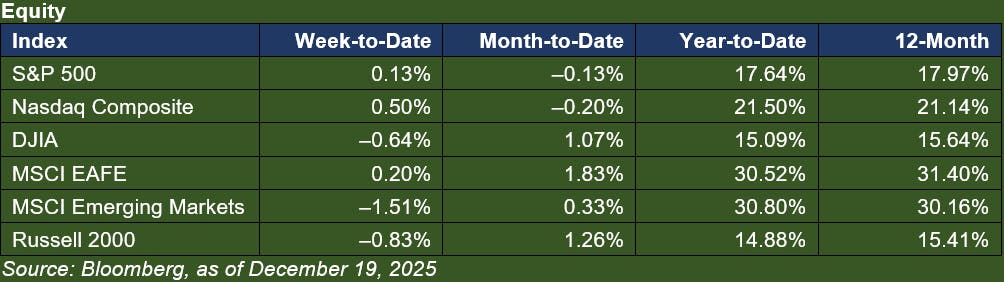
Stocks were once again mixed. The Nasdaq and the S&P 500 rose modestly but the Dow Jones and the small-cap Russell 2000 closed lower. Sectors that rallied included consumer discretionary, materials, health care, and technology. Cyclical and value stocks relinquished the previous week’s gains, led by declines in the energy, real estate, consumer staples, and industrial sectors.
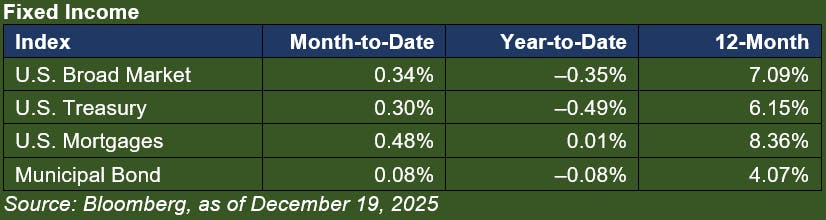
The Treasury market was stronger across the curve, with yields declining 4–6 basis points (bps). The yield on the 10-year closed at 4.144 percent. Investors continued to digest the previous week’s Fed meeting and mixed economic data released throughout the week.
The Takeaway
· Equities were mixed as investors reversed some of the previous week’s sector rotation. More growth-oriented sectors led the way as cyclical and value sectors gave up some of the previous week’s gains.
· Conversely, Treasury bonds rallied across the yield curve. Investors weighed mixed economic data as they continued to digest the previous week’s FOMC meeting outcome.
Looking Ahead
This week, we expect two important reports to be released on Tuesday:
· The delayed third-quarter GDP report is expected to show solid growth of more than 3 percent.
· After falling to a seven-month low in November, the Conference Board Consumer Confidence Index for December is anticipated to show modest improvement.
Disclosures: This material is intended for informational/educational purposes only and should not be construed as investment advice, a solicitation, or a recommendation to buy or sell any security or investment product. Diversification does not assure a profit or protect against loss in declining markets, and diversification cannot guarantee that any objective or goal will be achieved. Please contact your financial professional for more information specific to your situation.
Bonds are subject to availability and market conditions; some have call features that may affect income. Bond prices and yields are inversely related: when the price goes up, the yield goes down, and vice versa. Market risk is a consideration if sold or redeemed prior to maturity.
Certain sections of this commentary contain forward-looking statements that are based on our reasonable expectations, estimates, projections, and assumptions. Forward-looking statements are not guarantees of future performance and involve certain risks and uncertainties, which are difficult to predict. All indices are unmanaged and are not available for direct investment by the public. Past performance is not indicative of future results. The S&P 500 is based on the average performance of the 500 industrial stocks monitored by Standard & Poor’s. The Nasdaq Composite Index measures the performance of all issues listed in the Nasdaq Stock Market, except for rights, warrants, units, and convertible debentures. The Dow Jones Industrial Average is computed by summing the prices of the stocks of 30 large companies and then dividing that total by an adjusted value, one which has been adjusted over the years to account for the effects of stock splits on the prices of the 30 companies. Dividends are reinvested to reflect the actual performance of the underlying securities. The MSCI EAFE Index is a float-adjusted market capitalization index designed to measure developed market equity performance, excluding the U.S. and Canada. The MSCI Emerging Markets Index is a market capitalization-weighted index composed of companies representative of the market structure of 26 emerging market countries in Europe, Latin America, and the Pacific Basin. The Russell 2000® Index measures the performance of the 2,000 smallest companies in the Russell 3000® Index. The Bloomberg US Aggregate Bond Index is an unmanaged market value-weighted performance benchmark for investment-grade fixed-rate debt issues, including government, corporate, asset-backed, and mortgage-backed securities with maturities of at least one year. The U.S. Treasury Index is based on the auctions of U.S. Treasury bills, or on the U.S. Treasury’s daily yield curve. The Bloomberg US Mortgage Backed Securities (MBS) Index is an unmanaged market value-weighted index of 15- and 30-year fixed-rate securities backed by mortgage pools of the Government National Mortgage Association (GNMA), Federal National Mortgage Association (Fannie Mae), and the Federal Home Loan Mortgage Corporation (FHLMC), and balloon mortgages with fixed-rate coupons. The Bloomberg US Municipal Index includes investment-grade, tax-exempt, and fixed-rate bonds with long-term maturities (greater than 2 years) selected from issues larger than $50 million. One basis point is equal to 1/100th of 1 percent, or 0.01 percent. One basis point (bp) is equal to 1/100th of 1 percent, or 0.01 percent.
###
Zachary Sturdy is located at 307 S Front St, Ste 107 Marquette, MI 49855 and can be reached at (906)226-6056. Securities and advisory services offered through Commonwealth Financial Network®, Member FINRA/SIPC, a Registered Investment Adviser. Fixed insurance products and services are separate from and not offered through Commonwealth Financial Network®.
Authored by the Investment Research team at Commonwealth Financial Network®.
© 2025 Commonwealth Financial Network®