Market Navigator—Week of October 6, 2025
Market Navigator—Week of October 6, 2025
Presented by Zachary R. Sturdy
---
U.S. equities extended gains, with all major indices reaching record highs amid optimism over potential Federal Reserve (Fed) easing and steady consumer resilience. Treasuries weakened and the yield curve flattened as stronger growth signals and mixed central bank commentary tempered rate cut expectations. Credit markets remained stable and spreads stayed tight.
Quick Hits
1. Beyond the headlines: Labor market softens as data gap adds uncertainty.
2. Report releases: Durable goods orders rose in August, signaling solid business investment.
3. Financial market data: Broad-based gains lifted equities to record highs as easing expectations and steady sentiment supported risk appetite.
4. Looking ahead: The focus this week will be on Fed meeting minutes, U.S. trade data, and
consumer confidence.
Beyond the Headlines: Labor Market Softens as Data Gap Adds Uncertainty
Recent labor indicators suggest that the U.S. labor market is losing momentum as the economy enters the fourth quarter. The September ADP employment report showed that private sector payrolls contracted by 32,000, their first decline since early 2023. The drop was largely driven by small and mid-sized firms, which shed a combined 60,000 positions; large employers added roughly 33,000. Hiring weakness was broad-based, with declines across professional and business services, financial activities, and leisure and hospitality. This was partially offset by gains in education and health services, which added 33,000 jobs. The data aligns with a broader slowdown in hiring demand and reflects employer caution amid persistent policy uncertainty and rising input costs.
Wage trends continued to moderate, supporting the view that labor-driven inflationary pressure is easing. Pay growth for job stayers was steady at 4.5 percent year-over-year, whereas job changers saw compensation gains slow to 6.6 percent from 7.1 percent in August. The largest deceleration occurred in cyclical industries such as leisure and hospitality and financial services, suggesting that firms in consumer-sensitive sectors are tightening compensation budgets in response to softer demand. Although pay growth remains above pre-pandemic averages, the pace has cooled meaningfully, offering the Fed some reassurance that the inflationary impulse from the labor market is diminishing.
Incomplete View of Labor Conditions
The Job Openings and Labor Turnover Survey (JOLTS) added to that narrative, showing that job openings were essentially flat from the previous month but well below highs from 2022. Hires and quits continued to trend lower, with the ratio of openings to unemployed workers narrowing to roughly 1.3 from 1.8 one year ago. This normalization points to a labor market that is rebalancing rather than collapsing. Employers remain reluctant to lay off workers but are less aggressive in hiring or bidding up wages.
Complicating the outlook, the official September employment report was not released because of the ongoing federal government shutdown, depriving investors and policymakers of key headline figures such as total nonfarm payrolls, the unemployment rate, and participation trends. The absence of these figures leaves the market with an incomplete view of overall labor conditions at a critical inflection point for monetary policy. Without confirmation from the Bureau of Labor Statistics, investors are forced to rely on private indicators such as ADP and JOLTS, which, though directionally informative, do not fully capture the breadth of the labor market.
Delicate Balance for Investors
For investors, the current backdrop presents a delicate balance. On one hand, the moderation in hiring and wage growth supports the case for additional policy easing, reinforcing the view that inflation is moving closer to the Fed’s 2 percent target. On the other hand, the data void complicates risk assessment and could heighten volatility if upcoming releases, once resumed, show sharper deterioration than expected. Equity markets may remain resilient as hopes for further Fed cuts persist, but the uncertainty around labor momentum and consumer durability warrants maintaining exposure to
higher-quality, defensive assets with strong balance sheets and stable cash flows.
Across portfolios, a balanced stance remains prudent. Slower hiring and cooling wage growth support a patient Fed, whereas still-elevated inflation and political uncertainty argue against an overly aggressive duration extension. Credit spreads have remained contained, reflecting faith in underlying economic resilience, but a prolonged shutdown or delayed policy clarity could shift sentiment quickly. The labor market remains functional yet fragile, steady enough to avoid recessionary fears but soft enough to keep investors cautious until data flow normalizes and the policy path becomes clearer.
Report Releases—September 29–October 3, 2025
Conference Board Consumer Confidence Index: September (Tuesday)
Consumer confidence fell more than expected, likely in part because of increased political uncertainty from Washington.
- Expected/prior month consumer confidence: 96.0/97.8
- Actual consumer confidence: 94.2
ISM Manufacturing Index: September (Wednesday)
Manufacturing activity improved modestly; however, the index remained in contractionary territory.
- Expected/prior month ISM Manufacturing index: 49/48.7
- Actual ISM Manufacturing index: 49.1
Employment Report: September (Friday)
Last month’s employment report has been delayed because of the federal government shutdown.
ISM Services Index: September (Friday)
Services missed expectations, narrowly escaping falling into contractionary territory.
- Expected/prior month ISM Services index: 52.0/52.0
- Actual ISM Services index: 50.0
The Takeaway
· Consumer confidence fell from 97.8 to 94.2 in September, missing expectations of 96 amid heightened political uncertainty and inflation concerns. This signaled softer household sentiment ahead of the holiday season.
· The much-anticipated September employment report was delayed amid the federal government shutdown, leaving investors without a critical read on labor market momentum.
Financial Market Data
Equity
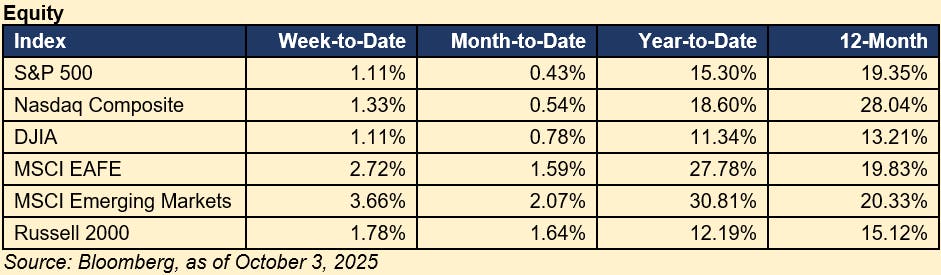
Equities advanced, fully reversing the previous week’s losses as all major indices reached record highs. Gains were broad-based, supported by optimism around additional potential rate cuts and resilience in the consumer sector. Defensive and growth-oriented sectors both participated, whereas energy lagged amid softer commodity prices. Despite ongoing political gridlock and delayed data releases, investor sentiment remained constructive heading into earnings season and key policy updates.
Fixed Income
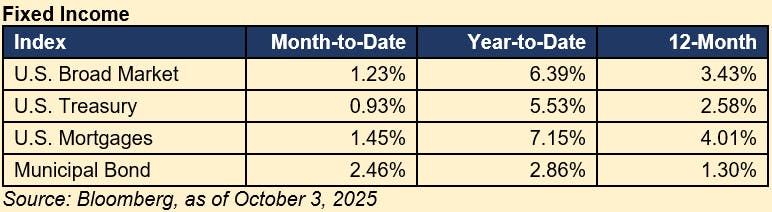
Treasuries weakened as the yield curve flattened, with tepid auction demand underscoring softer foreign participation. Investors pared expectations for multiple near-term rate cuts after solid housing data, firm capital goods orders, and a GDP revision signaled resilient growth. Divergent Fed commentary added uncertainty. Credit markets remained stable and spreads stayed tight despite renewed tariff headlines and rising geopolitical risks.
The Takeaway
· Equities climbed to record highs as broad-based gains reflected optimism over potential rate cuts and resilient economic data, with sentiment staying constructive despite political gridlock and delayed reports.
· Treasuries weakened and the yield curve flattened as stronger growth indicators and mixed Fed commentary led investors to scale back expectations for additional near-term easing.
Looking Ahead
This week, the focus shifts to the Fed, trade, and consumer confidence.
· Numerous Fed members are expected to speak this week.
· On Tuesday, we expect the release of the U.S. trade balance for August. Expectations are calling for a deficit of $60.7 billion, down from $78.3 billion.
· Federal Open Market Committee (FOMC) meeting minutes for September will be released on Wednesday. The minutes should provide insight into the central bank’s decision to cut interest rates 25 basis points (bps).
· Finally, on Friday, we expect the University of Michigan consumer sentiment survey for October. Sentiment isn’t expected to change much.
Disclosures: This material is intended for informational/educational purposes only and should not be construed as investment advice, a solicitation, or a recommendation to buy or sell any security or investment product. Diversification does not assure a profit or protect against loss in declining markets, and diversification cannot guarantee that any objective or goal will be achieved. Please contact your financial professional for more information specific to your situation.
Bonds are subject to availability and market conditions; some have call features that may affect income. Bond prices and yields are inversely related: when the price goes up, the yield goes down, and vice versa. Market risk is a consideration if sold or redeemed prior to maturity.
Certain sections of this commentary contain forward-looking statements that are based on our reasonable expectations, estimates, projections, and assumptions. Forward-looking statements are not guarantees of future performance and involve certain risks and uncertainties, which are difficult to predict. All indices are unmanaged and are not available for direct investment by the public. Past performance is not indicative of future results. The S&P 500 is based on the average performance of the 500 industrial stocks monitored by Standard & Poor’s. The Nasdaq Composite Index measures the performance of all issues listed in the Nasdaq Stock Market, except for rights, warrants, units, and convertible debentures. The Dow Jones Industrial Average is computed by summing the prices of the stocks of 30 large companies and then dividing that total by an adjusted value, one which has been adjusted over the years to account for the effects of stock splits on the prices of the 30 companies. Dividends are reinvested to reflect the actual performance of the underlying securities. The MSCI EAFE Index is a float-adjusted market capitalization index designed to measure developed market equity performance, excluding the U.S. and Canada. The MSCI Emerging Markets Index is a market capitalization-weighted index composed of companies representative of the market structure of 26 emerging market countries in Europe, Latin America, and the Pacific Basin. The Russell 2000® Index measures the performance of the 2,000 smallest companies in the Russell 3000® Index. The Bloomberg US Aggregate Bond Index is an unmanaged market value-weighted performance benchmark for investment-grade fixed-rate debt issues, including government, corporate, asset-backed, and mortgage-backed securities with maturities of at least one year. The U.S. Treasury Index is based on the auctions of U.S. Treasury bills, or on the U.S. Treasury’s daily yield curve. The Bloomberg US Mortgage Backed Securities (MBS) Index is an unmanaged market value-weighted index of 15- and 30-year fixed-rate securities backed by mortgage pools of the Government National Mortgage Association (GNMA), Federal National Mortgage Association (Fannie Mae), and the Federal Home Loan Mortgage Corporation (FHLMC), and balloon mortgages with fixed-rate coupons. The Bloomberg US Municipal Index includes investment-grade, tax-exempt, and fixed-rate bonds with long-term maturities (greater than 2 years) selected from issues larger than $50 million. One basis point is equal to 1/100th of 1 percent, or 0.01 percent. One basis point (bp) is equal to 1/100th of 1 percent, or 0.01 percent.
###
Zachary Sturdy is located at 307 S Front St, Ste 107 Marquette, MI 49855 and can be reached at (906)226-6056. Securities and advisory services offered through Commonwealth Financial Network®, Member FINRA/SIPC, a Registered Investment Adviser. Fixed insurance products and services are separate from and not offered through Commonwealth Financial Network®.
Authored by the Investment Research team at Commonwealth Financial Network®.
© 2025 Commonwealth Financial Network®