Market Navigator—Week of October 13, 2025
Market Navigator—Week of October 13, 2025
Presented by Zachary R. Sturdy
---
U.S. equities were down last week after a late sell-off. Although stocks set another all-time high midweek, Friday was the worst day for equities since April as renewed concerns about trade negotiations and tariffs between the U.S. and China dragged markets down. Treasuries rallied modestly, in large part because of a flight to quality related to the equity decline.
Quick Hits
1. Beyond the headlines: AI expectations stay elevated as market broadens.
2. Report releases: The Federal Reserve (Fed) cited the labor market as the main reason for its September rate cut.
3. Financial market data: Equity markets sold off on concerns about trade negotiations with China.
4. Looking ahead: The focus this week will be on earnings reports from big banks and Fed commentary.
Keep reading for an in-depth look.
Beyond the Headlines: AI Expectations Stay Elevated as Market Broadens
Heading into third-quarter earnings season, investor enthusiasm around artificial intelligence remains intense but the bar for tech leaders to deliver upside has risen sharply. Although early beneficiaries such as Nvidia and Microsoft have already priced in strong growth, recent developments across hardware, energy, and software highlight a new phase of the AI cycle defined by rising costs, tighter margins, and the need for sustained investment.
Oracle’s latest results underscored this shift. Despite solid demand for cloud infrastructure and AI workloads, margins narrowed as capital spending climbed to support data center expansion. Investors appear less willing to reward revenue growth that comes at the expense of profitability, a sign that expectations for core AI names are already lofty. Similar pressures are evident across the ecosystem as companies spend heavily on GPUs, power capacity, and real estate to meet demand, testing market patience after two years of outsized gains.
AI Power Demand
Power shortages in regions with dense AI buildouts, including parts of the southern U.S. and Europe, have raised costs for hyperscalers and cloud operators. Data center electricity demand is projected to more than double by 2030, spurring investment in grid modernization and nuclear capacity. These pressures create opportunities for industrial and utility companies supporting AI infrastructure, signaling a broadening of the AI rally beyond software and semiconductors.
Corporate guidance trends echo that optimism, particularly within information technology. The number of S&P 500 companies issuing positive earnings-per-share guidance this quarter has surged to its highest level since 2021, led by the IT sector, with a record 36 firms well above historical averages. Software and semiconductor companies dominate, reflecting confidence in AI-driven demand and improved operating leverage. The sector also carries the highest expected earnings growth of any S&P 500 group at about 21 percent year-over-year, reinforcing its leadership in profitability momentum.
OpenAI’s recent developer day highlighted how innovation is expanding. The company unveiled platform updates that simplify enterprise adoption and speed application development, fueling another phase of monetization in generative AI. As Nvidia President and CEO Jensen Huang noted, “AI demand is up substantially and still growing,” underscoring both the opportunity and the challenge of scaling profitably in a capital-intensive cycle.
Macro Conditions Favor Hard Assets
Meanwhile, macro conditions continue to favor hard assets. Gold has surged as investors hedge against fiscal strain and geopolitical risk, and industrial metals tied to data center and grid buildouts have strengthened. This intersection between digital expansion and physical resource demand suggests the AI story is evolving into a more balanced investment theme that includes infrastructure and commodities alongside growth.
For investors, the AI narrative remains powerful, but leadership is broadening beyond core chip and software names, which now face a high earnings hurdle. Portfolios emphasizing quality companies with strong margins, disciplined capital spending, and durable demand alongside selective exposure to infrastructure and hard assets may offer a more resilient path as markets test whether the AI boom can sustain both innovation and profitability.
Report Releases—October 6–10, 2025
Fed Speakers: Week of October 6–10
Fed Chair Jerome Powell continued to emphasize a cautious and data-dependent approach to future rate cuts. Other central bank members were split, with Jeffrey Schmid and Michael Barr more hesitant on future rate cuts and Stephen Miran and Michelle Bowman more dovish on additional cuts.
U.S. Trade Balance: August (Tuesday)
The U.S. trade balance report for August was delayed by the government shutdown. Expectations were for a drop to a deficit of $60.7 billion, down from $78.3 billion in July.
Federal Open Market Committee (FOMC) Meeting Minutes: September (Wednesday)
Minutes from the Fed’s September meeting showed that concerns about the health of the labor market were the primary driver for the central bank’s 25 basis point (bps) interest rate reduction.
University of Michigan Consumer Sentiment Survey: October (Friday)
Consumer sentiment ticked down 0.1 point as the index stayed relatively flat and beat expectations for a deeper decline.
- Expected/prior month sentiment: 54.2/55.1
- Actual month sentiment: 55.0
The Takeaway
· As Powell maintained a cautious, data-driven stance, Fed officials delivered mixed messages, highlighting policy divisions; Schmid and Barr pushed back on cuts, whereas Miran and Bowman advocated for additional easing.
· The August trade balance report was delayed by the government shutdown, limiting insight into recent export and import trends.
Financial Market Data
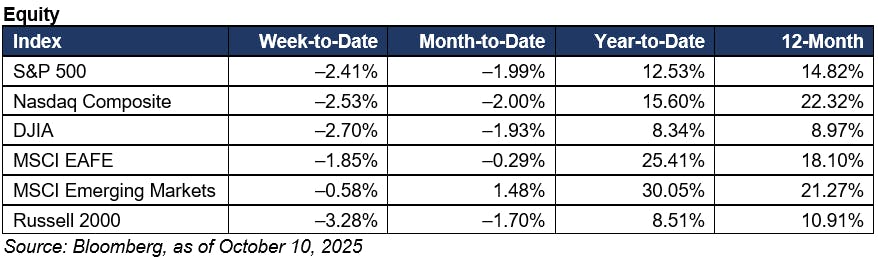
Equities declined on news that progress on a trade deal with China had stalled. Renewed possibilities that the U.S. could implement significant tariffs on China because of its policies surrounding rare earth minerals caused a sell-off on Friday, dragging major indices down. Defensive sectors, such as utilities, health care, and consumer staples, gained. Energy and materials lagged alongside softer commodities. Consumer discretionary, industrials, and technology also declined. Corporate sentiment remained positive, however, with the information technology sector driving a record pace of upbeat earnings guidance. Markets now look toward upcoming earnings for confirmation of the AI-driven growth narrative.
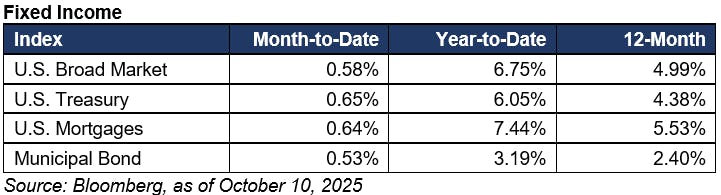
Treasury yields moved lower on a flight to quality due to the sell-off in equity markets. Concerns about the labor market and inflation remained a focus for investors. As the government shutdown puts much of the key data around these topics on hold, Fed speakers and September FOMC meeting minutes tempered expectations for near-term policy easing. Meanwhile, investors are left to balance other signs of slowing growth against still-firm inflation pressures. Demand for higher-quality assets persisted, and credit spreads remained stable or widened slightly. Attention now turns to the Fed for clarity on the timing and pace of potential rate adjustments into early 2026.
The Takeaway
· Equities sold off on renewed concerns surrounding trade negotiations with China, particularly around the availability of rare earth minerals.
· Treasuries rallied modestly on a flight to quality due to the decline in equities. Mixed economic data and cautious Fed commentary tempered near-term easing expectations.
Looking Ahead
This week will center on key inflation and housing data.
· Fundamentals will return to focus with third-quarter earnings kicking off in earnest this week. Major banks, led by J.P. Morgan, Goldman Sachs, and Bank of America, will report on Wednesday and Thursday.
· With most economic data from the government on hold during the shutdown, Wednesday’s Beige Book release will be the focus of investors. (Fed Chair Powell will speak on Tuesday.)
Disclosures: This material is intended for informational/educational purposes only and should not be construed as investment advice, a solicitation, or a recommendation to buy or sell any security or investment product. Diversification does not assure a profit or protect against loss in declining markets, and diversification cannot guarantee that any objective or goal will be achieved. Please contact your financial professional for more information specific to your situation.
Bonds are subject to availability and market conditions; some have call features that may affect income. Bond prices and yields are inversely related: when the price goes up, the yield goes down, and vice versa. Market risk is a consideration if sold or redeemed prior to maturity.
Certain sections of this commentary contain forward-looking statements that are based on our reasonable expectations, estimates, projections, and assumptions. Forward-looking statements are not guarantees of future performance and involve certain risks and uncertainties, which are difficult to predict. All indices are unmanaged and are not available for direct investment by the public. Past performance is not indicative of future results. The S&P 500 is based on the average performance of the 500 industrial stocks monitored by Standard & Poor’s. The Nasdaq Composite Index measures the performance of all issues listed in the Nasdaq Stock Market, except for rights, warrants, units, and convertible debentures. The Dow Jones Industrial Average is computed by summing the prices of the stocks of 30 large companies and then dividing that total by an adjusted value, one which has been adjusted over the years to account for the effects of stock splits on the prices of the 30 companies. Dividends are reinvested to reflect the actual performance of the underlying securities. The MSCI EAFE Index is a float-adjusted market capitalization index designed to measure developed market equity performance, excluding the U.S. and Canada. The MSCI Emerging Markets Index is a market capitalization-weighted index composed of companies representative of the market structure of 26 emerging market countries in Europe, Latin America, and the Pacific Basin. The Russell 2000® Index measures the performance of the 2,000 smallest companies in the Russell 3000® Index. The Bloomberg US Aggregate Bond Index is an unmanaged market value-weighted performance benchmark for investment-grade fixed-rate debt issues, including government, corporate, asset-backed, and mortgage-backed securities with maturities of at least one year. The U.S. Treasury Index is based on the auctions of U.S. Treasury bills, or on the U.S. Treasury’s daily yield curve. The Bloomberg US Mortgage Backed Securities (MBS) Index is an unmanaged market value-weighted index of 15- and 30-year fixed-rate securities backed by mortgage pools of the Government National Mortgage Association (GNMA), Federal National Mortgage Association (Fannie Mae), and the Federal Home Loan Mortgage Corporation (FHLMC), and balloon mortgages with fixed-rate coupons. The Bloomberg US Municipal Index includes investment-grade, tax-exempt, and fixed-rate bonds with long-term maturities (greater than 2 years) selected from issues larger than $50 million. One basis point is equal to 1/100th of 1 percent, or 0.01 percent. One basis point (bp) is equal to 1/100th of 1 percent, or 0.01 percent.
###
Zachary Sturdy is located at 307 S Front St, Ste 107 Marquette, MI 49855 and can be reached at (906)226-6056. Securities and advisory services offered through Commonwealth Financial Network®, Member FINRA/SIPC, a Registered Investment Adviser. Fixed insurance products and services are separate from and not offered through Commonwealth Financial Network®.
Authored by the Investment Research team at Commonwealth Financial Network®.
© 2025 Commonwealth Financial Network®