Market Navigator—Week of January 5, 2026
Market Navigator—Week of January 5, 2026
Presented by Zachary R. Sturdy
---
In a holiday-shortened trading week, the lackluster performance of U.S. equities was the theme. All major indices declined, with the Nasdaq, down 1.5 percent, being the worst performing. Growth-oriented stocks came under pressure, as investors once again rotated into more economically sensitive stocks like energy. Treasuries declined as well, as yields on the 10-year bond rose 5 basis points to just under
4.2 percent.
Quick Hits
1. Beyond the Headlines: What could 2026 bring?
2. Report releases: The delayed third-quarter GDP report showed continued strong momentum in the U.S. economy, led by consumer spending. The December FOMC meeting minutes showed the committee divided on interest rates.
3. Financial market data: The Nasdaq led the decline, with equity markets down across the board in a quiet, holiday-shortened week. Energy stocks were the best performing part of the market.
4. Looking ahead: This week, we expect to see the December employment report on Friday and readings on manufacturing and service sector confidence.
Beyond the Headlines: What Could 2026 Bring?
With 2025 now behind us, some clear takeaways have emerged: headlines, policy proposals, and new technologies can cause markets to move quickly in the short term. Declining markets cause emotions to run high but can also create opportunities.
As we settle into the new year, the economy continues to show signs of resilience, and corporate earnings growth remains robust. The U.S. economy is likely to remain in growth mode in 2026, as it benefits from fiscal stimulus and potential continued easing from the Federal Reserve (Fed). Corporate executives have confidence in the long term, as evidenced by increased M&A activity and the strength of earnings growth from the S&P 500. While valuations entered the year elevated compared to historical averages, the combination of economic growth, earnings growth, and increased corporate spending on deals and technology should provide a supportive backdrop for investors.
Of course, risks remain. Policy uncertainty isn’t likely to go away. Plus, the Fed’s focus on its dual mandate of employment and inflation has led to divisions among the voting members of the Federal Open Market Committee (FOMC) and creates an unclear picture of how aggressive the central bank may be when cutting rates in the upcoming year.
Foreign risks remain as well, with ongoing conflicts in Europe, the Middle East, and the recent actions in Venezuela serving as continued sources of regional instability. While U.S. markets tend to react to these types of risks only when they impact the U.S. economy and corporate earnings, these sources of geopolitical uncertainty should be monitored, as they could negatively impact markets in the future.
Despite the risks, a dramatic shift in the big picture doesn’t appear likely. A modest economic slowdown is anticipated to start 2026, with a rebound later in the year. The slowdown in the labor market will be felt in the first half of the year and will have an impact on consumer spending. But strength in the high-end consumer and continued spending on artificial intelligence (AI) buildout should keep growth in positive territory in the early part of the year. The 75 basis points of Fed easing in the fourth quarter and stimulus from the One Big Beautiful Bill Act should power growth in the second half of the year.
As it pertains to the market, we remain in a pretty good place to start the year. Market fundamentals were impressively resilient throughout the course of 2025, with further improvements expected for corporate earnings. Risks always exist. Despite them, the economic background is still supportive for investors. The most likely path forward remains continued economic and earnings growth leading to market appreciation in the year ahead, despite the potential for short-term setbacks along the way.
We believe that the AI theme has legs to it and that an allocation to technology and large-cap growth remains key to portfolio construction. We also continue to believe that diversification will play an important role. Owning some areas composed of value companies, mid- and small-cap companies, and international holdings should help navigate volatility in the AI names.
There is also a place for fixed income in a well-diversified portfolio. Current yields on high-quality bonds may give clients the chance to lock in income in the intermediate part of the curve. As they have done historically, we believe bonds should continue to act as a buffer during periods of equity market volatility.
This year will surely bring a new set of surprises to consensus views. As we learned in 2025, these periods tend to be full of investment opportunities. While short-term headlines may introduce volatility, staying focused on big-picture fundamentals provides a clearer guide for portfolio decisions and opportunities to take advantage of these periods.
Report Releases— December 22, 2025– January 2, 2026
Third-Quarter Real GDP (Tuesday, December 23)
The delayed third-quarter GDP report came in above expectations. Strong consumer spending led the way, with lower imports providing a boost.
· Expected/prior quarter annualized third-quarter GDP: 3.3%/3.8%
· Actual third-quarter GDP: 4.3%
FOMC Meeting Minutes for December (Wednesday, December 31)
The minutes from the December Fed meeting showed that members remained divided ahead of their decision to ultimately cut interest rates by 25 basis points.
The Takeaway
· The delayed release of the third-quarter GDP showed strong momentum in the U.S. economy. Consumers continued to spend at a strong rate, which helped power the 4.3 percent growth. Lower imports also played a role in the GDP strength. The release of the December FOMC meeting minutes reiterated what was clear during Chairman Powell’s post-meeting press conference—the voting members remain divided on the future path of interest rates as they try to balance their dual mandate of employment and inflation.
Financial Market Data
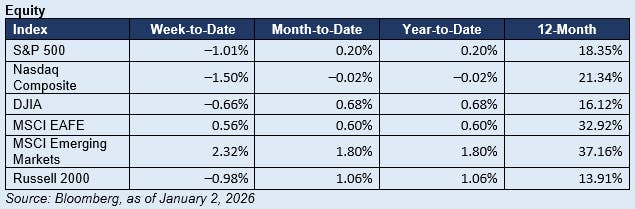
Markets turned in lackluster performance as 2025 came to an end and the calendar flipped to 2026. All major indices declined, with the Nasdaq leading the way, down 1.5 percent. The consumer discretionary, technology, and financial sectors led the market lower. Energy, utilities, and industrials stocks gained in the week.
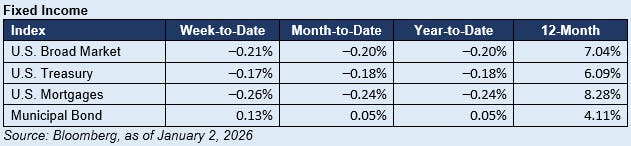
The Treasury market sold off slightly after the release of the December FOMC minutes. Ten-year Treasury yields increased about 5 basis points to close the week just under 4.2 percent.
The Takeaway
· In a quiet holiday-shortened week, equities declined across the board. The Nasdaq led the way lower, as technology came under pressure. Some of the value sectors rallied, led by
energy stocks.
· Bonds also sold off marginally in the week. If, when, and how much the Fed will reduce interest rates in 2026 remains a focus of fixed income investors.
Looking Ahead
This week, we expect to see these important reports:
· The all-important update on jobs with the December employment report, which is likely to consist of clean data given the reopening of the government
· Readings from ISM on both manufacturing and services sector confidence
· The University of Michigan January Consumer Sentiment
Disclosures: This material is intended for informational/educational purposes only and should not be construed as investment advice, a solicitation, or a recommendation to buy or sell any security or investment product. Please contact your financial professional for more information specific to your situation.
Certain sections of this commentary contain forward-looking statements that are based on our reasonable expectations, estimates, projections, and assumptions. Forward-looking statements are not guarantees of future performance and involve certain risks and uncertainties, which are difficult to predict. All indices are unmanaged and are not available for direct investment by the public. Past performance is not indicative of future results. The S&P 500 is based on the average performance of the 500 industrial stocks monitored by Standard & Poor’s. The Nasdaq Composite Index measures the performance of all issues listed in the Nasdaq Stock Market, except for rights, warrants, units, and convertible debentures. The Dow Jones Industrial Average is computed by summing the prices of the stocks of 30 large companies and then dividing that total by an adjusted value, one which has been adjusted over the years to account for the effects of stock splits on the prices of the 30 companies. Dividends are reinvested to reflect the actual performance of the underlying securities. The MSCI EAFE Index is a float-adjusted market capitalization index designed to measure developed market equity performance, excluding the U.S. and Canada. The MSCI Emerging Markets Index is a market capitalization-weighted index composed of companies representative of the market structure of 26 emerging market countries in Europe, Latin America, and the Pacific Basin. The Russell 2000® Index measures the performance of the 2,000 smallest companies in the Russell 3000® Index. The Bloomberg US Aggregate Bond Index is an unmanaged market value-weighted performance benchmark for investment-grade fixed-rate debt issues, including government, corporate, asset-backed, and mortgage-backed securities with maturities of at least one year. The U.S. Treasury Index is based on the auctions of U.S. Treasury bills, or on the U.S. Treasury’s daily yield curve. The Bloomberg US Mortgage Backed Securities (MBS) Index is an unmanaged market value-weighted index of 15- and 30-year fixed-rate securities backed by mortgage pools of the Government National Mortgage Association (GNMA), Federal National Mortgage Association (Fannie Mae), and the Federal Home Loan Mortgage Corporation (FHLMC), and balloon mortgages with fixed-rate coupons. The Bloomberg US Municipal Index includes investment-grade, tax-exempt, and fixed-rate bonds with long-term maturities (greater than 2 years) selected from issues larger than $50 million. One basis point is equal to 1/100th of 1 percent, or 0.01 percent. One basis point (bp) is equal to 1/100th of 1 percent, or 0.01 percent.
###
Zachary Sturdy is located at 307 S Front St, Ste 107 Marquette, MI 49855 and can be reached at (906)226-6056. Securities and advisory services offered through Commonwealth Financial Network®, Member FINRA/SIPC, a Registered Investment Adviser. Fixed insurance products and services are separate from and not offered through Commonwealth Financial Network®.
Authored by the Investment Research team at Commonwealth Financial Network®.
© 2026 Commonwealth Financial Network®