Market Navigator—Week of November 17, 2025
Market Navigator—Week of November 17, 2025
Presented by Zachary R. Sturdy
---
U.S. equities were mixed, with continuing investor concerns about companies earning a return on their AI spending. Divergent views by Federal Reserve (Fed) Fed officials about the potential for an interest rate cut next month led to weakness in the Treasury market. With the longest government shutdown ending, delayed economic data will begin to be released.
Quick Hits
1. Beyond the headlines: December Fed meeting: Will they or won’t they?
2. Report releases: There were no major economic reports because of the government shutdown.
3. Financial market data: Equities were mixed. Value stocks rallied and technology stocks remained under pressure. Treasuries were weaker.
4. Looking ahead: Delayed economic reports will resume this week, beginning with the September jobs report and housing market data.
Keep reading for an in-depth look.
Beyond the Headlines: December Fed Meeting: Will They or Won’t They?
Now that the longest government shutdown has ended after 43 days, investors and Fed officials will focus on the release of delayed economic reports and a more normal data release schedule. But questions remain: what data will be released before the Federal Open Market Committee (FOMC) meets on December 9–10, and how robust will the data collection be?
We know we will receive the September employment report on Thursday. Because this data was collected before the shutdown began, it will be normal and detailed; unfortunately, it will also be stale. Nonetheless, it will provide missing data on the health of the jobs market in the early fall. Some inflation data from September might also be close to normal in terms of collection process and detail.
Data Outlook Hazy
After that, it gets a little foggy. The White House has indicated that October data is unlikely to be reported. The Bureau of Labor Statistics said some data for October employment had been collected and would be released, but added that it would not be complete. That is likely to be true for most October data—if it is released, it won’t be complete. So, though investors and Fed officials will benefit in terms of identifying trends, they won’t receive as much information as they normally do.
That leads to November data. Does the government have enough time to collect data, given the late start and the upcoming Thanksgiving week? Maybe, but perhaps not in time for the Fed’s meeting. The November employment report is scheduled to be released on December 5, the Friday before the meeting. It’s possible it won’t be released on time, and even if it is, it might be incomplete.
Slowing Down in Fog
During his October post-meeting news conference, Chair Jerome Powell said, “What do you do if you are driving in a fog? You slow down.” This point looms. Before the FOMC decided to cut interest rates in October, odds for another cut in December exceeded 90 percent. Currently, they are 50/50 at best. Fed comments since then have shown division within the voting committee about the appropriate path forward. There is a distinct possibility that the central bank will choose not to cut rates in December as it waits for clarity on where economic growth, employment, and inflation are. Hopefully, this will come in the December economic releases scheduled for January. (The next FOMC meeting is January 27–28.)
Investor sentiment improves when the Fed is easing, so a central bank pause in December could increase short-term volatility. Corporate earnings growth, however, continues to be stronger than expected and should be supportive of markets in the intermediate term.
Report Releases—November 10–14, 2025
There were no major economic updates because of the recent government shutdown. Fed commentary continued to show a division as to whether interest rates would be cut at the FOMC’s December meeting.
The Takeaway
· Economic data has been scarce due to the government shutdown.
· Investors are focused on commentary from Fed officials to determine whether interest rates will be reduced again in December.
Financial Market Data
Equity
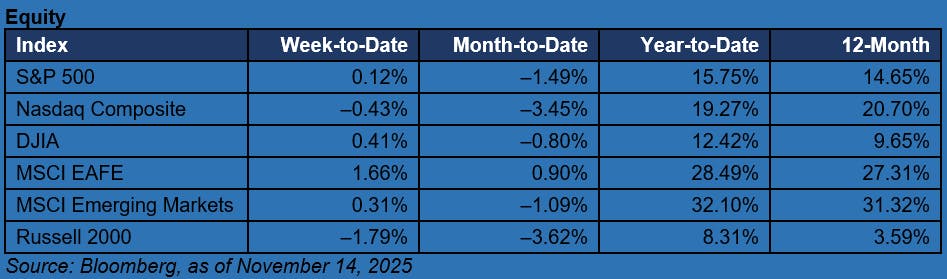
The Dow Jones Industrial Average and the S&P 500 eked out small gains; the Nasdaq Composite closed slightly down. The biggest theme was a respite from the large-cap growth companies that have led the market over the past several years, offset by a rotation into more traditional value companies. Strength was seen in health care, materials, energy, and consumer staples. Lagging sectors were consumer discretionary, utilities, and real estate.
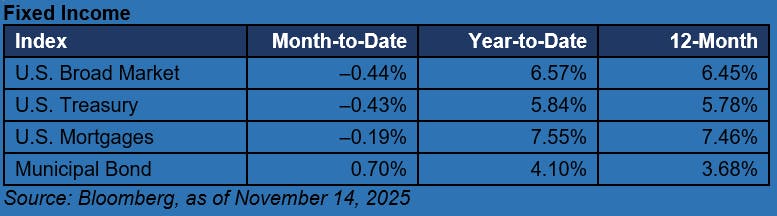
Treasuries were weaker across the curve. Fed commentary continued to show divergent views on whether interest rates should be reduced again at the December FOMC meeting. Market expectations have dropped to 50/50 on whether there will be a rate cut.
The Takeaway
· Equities were mixed, with the Nasdaq down and other indices up slightly. Value companies rallied, whereas AI stocks were mixed to down.
· Concerns about whether the Fed would reduce interest rates in December caused Treasury yields to move higher and bonds to decline across the curve.
Looking Ahead
This week, we’ll see economic reports that were delayed due to the government shutdown, with the focus on the September employment report on Thursday. We’ll also receive updates on the housing market, along with more comments from Fed officials and minutes from the October FOMC meeting. Several earnings reports are also expected.
· Economic data, delayed during the 43-day government shutdown, begins to be released. The focus will be on Thursday’s employment report for September. Housing updates, Fed commentary, and October FOMC meeting minutes are also on the radar.
· A handful of companies still have earnings to report. Nvidia will be the biggest focus, but we also expect reports from Home Depot, Lowes, Target, and Walmart.
Disclosures: This material is intended for informational/educational purposes only and should not be construed as investment advice, a solicitation, or a recommendation to buy or sell any security or investment product. Diversification does not assure a profit or protect against loss in declining markets, and diversification cannot guarantee that any objective or goal will be achieved. Please contact your financial professional for more information specific to your situation.
Bonds are subject to availability and market conditions; some have call features that may affect income. Bond prices and yields are inversely related: when the price goes up, the yield goes down, and vice versa. Market risk is a consideration if sold or redeemed prior to maturity.
Certain sections of this commentary contain forward-looking statements that are based on our reasonable expectations, estimates, projections, and assumptions. Forward-looking statements are not guarantees of future performance and involve certain risks and uncertainties, which are difficult to predict. All indices are unmanaged and are not available for direct investment by the public. Past performance is not indicative of future results. The S&P 500 is based on the average performance of the 500 industrial stocks monitored by Standard & Poor’s. The Nasdaq Composite Index measures the performance of all issues listed in the Nasdaq Stock Market, except for rights, warrants, units, and convertible debentures. The Dow Jones Industrial Average is computed by summing the prices of the stocks of 30 large companies and then dividing that total by an adjusted value, one which has been adjusted over the years to account for the effects of stock splits on the prices of the 30 companies. Dividends are reinvested to reflect the actual performance of the underlying securities. The MSCI EAFE Index is a float-adjusted market capitalization index designed to measure developed market equity performance, excluding the U.S. and Canada. The MSCI Emerging Markets Index is a market capitalization-weighted index composed of companies representative of the market structure of 26 emerging market countries in Europe, Latin America, and the Pacific Basin. The Russell 2000® Index measures the performance of the 2,000 smallest companies in the Russell 3000® Index. The Bloomberg US Aggregate Bond Index is an unmanaged market value-weighted performance benchmark for investment-grade fixed-rate debt issues, including government, corporate, asset-backed, and mortgage-backed securities with maturities of at least one year. The U.S. Treasury Index is based on the auctions of U.S. Treasury bills, or on the U.S. Treasury’s daily yield curve. The Bloomberg US Mortgage Backed Securities (MBS) Index is an unmanaged market value-weighted index of 15- and 30-year fixed-rate securities backed by mortgage pools of the Government National Mortgage Association (GNMA), Federal National Mortgage Association (Fannie Mae), and the Federal Home Loan Mortgage Corporation (FHLMC), and balloon mortgages with fixed-rate coupons. The Bloomberg US Municipal Index includes investment-grade, tax-exempt, and fixed-rate bonds with long-term maturities (greater than 2 years) selected from issues larger than $50 million. One basis point is equal to 1/100th of 1 percent, or 0.01 percent. One basis point (bp) is equal to 1/100th of 1 percent, or 0.01 percent.
###
Zachary Sturdy is located at 307 S Front St, Ste 107 Marquette, MI 49855 and can be reached at (906)226-6056. Securities and advisory services offered through Commonwealth Financial Network®, Member FINRA/SIPC, a Registered Investment Adviser. Fixed insurance products and services are separate from and not offered through Commonwealth Financial Network®.
Authored by the Investment Research team at Commonwealth Financial Network®.
© 2025 Commonwealth Financial Network®