Market Navigator — Week of November 3, 2025
Market Navigator—Week of November 3, 2025
Presented by Zachary R. Sturdy
---
Led by the Nasdaq Composite, U.S. equities rose last week. Other indices had more muted returns, and the small-cap Russell 2000 declined for the first time in four weeks. Stocks sold off midweek after the Federal Reserve (Fed) lowered interest rates 25 basis points (bps), but stronger earnings led to a late-week rally. Treasuries declined modestly.
Quick Hits
1. Beyond the headlines: What can Berkshire’s earnings tell us about Warren Buffett’s market views?
2. Report releases: Consumer confidence continued to decline but was slightly better than expected. The Fed cut rates 25 bps but didn’t commit to doing so next month.
3. Financial market data: Equity markets, paced by the Nasdaq, rallied. The small-cap Russell 2000 declined for the first time in four weeks.
4. Looking ahead: We expect earnings data, updates on business and consumer confidence, and another employment report from ADP.
Keep reading for an in-depth look.
Beyond the Headlines: What Can Berkshire’s Earnings Tell Us About Warren Buffett’s Market Views?
Based on his long history of adding value for shareholders of Berkshire Hathaway, Warren Buffett is one of the nation’s best-known investors. Berkshire earnings are therefore often scrutinized to see what can be gleaned regarding Buffett’s view of stocks.
Media headlines picked up one of the takeaways—cash balances rose. Berkshire now has $381.7 billion in cash and short-term Treasuries, up from $344 billion at the end of the second quarter and above the previous high ($347.7 billion) from the end of the first quarter. There was a payable due that reduced the headline number to a net cash position of $358 billion, but it nonetheless seemed as though the high cash balance might indicate a lack of better options. But is that true?
Net Seller for 12 Consecutive Quarters
Berkshire was a net seller of stocks last quarter, to the tune of just more than $6 billion. Peeling back the layers, however, it sold roughly $12 billion of stocks and purchased $6 billion. So, it wasn’t as if the firm found no attractive market opportunities. It was, however, the 12th consecutive quarter in which Berkshire was a net seller. At the same time, Berkshire didn’t buy back any of its stock for the fifth consecutive quarter. The stock has declined 11.5 percent–12 percent since it was announced in May that Buffett would step down at the end of the year.
And that could be a reasonable explanation why Berkshire is building cash and not investing it in any meaningful way. Buffett simply may have decided it isn’t appropriate to make a big acquisition or invest a large portion of the cash balance because he is leaving at the end of December; instead, it probably makes sense that his successor, Greg Abel, makes those decisions after becoming CEO.
Opportunities Exist
Interestingly, in early October, the company announced it was spending $9.7 billion to acquire Occidental Petroleum’s petrochemical business. Although this is a tiny percentage of Berkshire’s cash balance, it is another indication that opportunities exist—and that the company won’t be shy about taking advantage of them.
Abel has been at Berkshire since 2000, when the company acquired MidAmerican Energy Holdings, where he was president. Well regarded by investors, Abel has been the heir apparent for several years. Because he lacks the investment reputation of his predecessor, he will have to prove his bona fides as he begins to deploy the cash balance. Whether he is successful is a topic for shareholders to decide. But it does not need to be a concern for market tea leaf readers who seek signs that Buffett is bearish or that the market is set to decline. Corporate successions take place all the time and can affect the timing of future decisions. This one is no different.
Report Releases—October 27–31, 2025
Conference Board Consumer Confidence Index: October (Tuesday)
Consumer confidence fell by slightly less than expected in October as consumer expectations continued to drop in face of higher inflation and concerns about the job market.
· Expected/prior month consumer confidence: 93.4/95.6
· Actual consumer confidence: 94.6
Federal Open Market Committee (FOMC) Rate Decision: October (Wednesday)
The FOMC lowered the range for the federal funds rate 25 bps. Post-meeting comments from Fed Chair Jerome Powell called into question whether another interest rate cut will take place in December.
- Expected/prior federal funds rate upper limit: 4.00%/4.25%
- Actual federal funds rate upper limit: 4.00%
The Takeaway
· In a pattern that has persisted for most of the year, consumer confidence continued to deteriorate because of tariffs and softening employment. Nonetheless, consumer spending remained solid.
· As expected, the Fed delivered a 25 bps rate cut. Although rhetoric called into question whether another cut is expected next month, market participants continued to anticipate that economic data will lead to a December reduction.
Financial Market Data
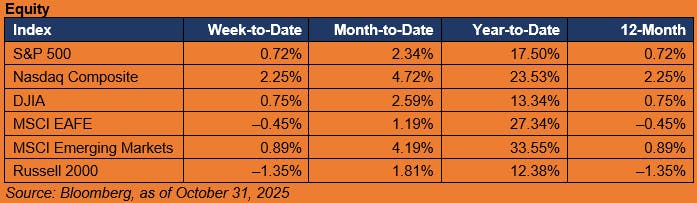
The Nasdaq buoyed markets, with the S&P 500 and Dow Jones Industrial Average also closing marginally higher. The small-cap Russell 2000 declined for the first time in four weeks. Cyclicals led the way, with gains in semiconductors; trucking and machinery; banks; and some metals. Lagging areas included home builders, airlines, casual restaurants, and managed care companies. The rally was choppy, but strong earnings from Alphabet and Amazon led to an upward bias by the end of the week.
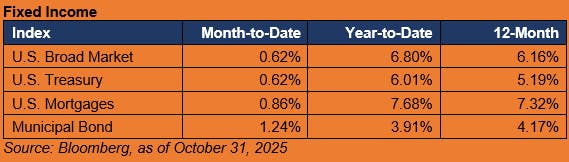
Treasury yields rose after Powell’s comments that a December interest rate cut was not guaranteed. The yield curve flattened, with the 2-year selling off more than the 10-year.
The Takeaway
· Led by the Nasdaq, equities rallied, but returns in other major indices were muted and the small-cap Russell 2000 declined for the first time in four weeks. Corporate earnings season continued to provide upbeat news about the health of companies across sectors and industries.
· Treasuries declined despite the Fed cutting interest rates 25 bps. Investors showed concern that the central bank might not cut rates in December after comments from Powell.
Looking Ahead
This week, the focus is on business and consumer confidence, the employment market, and corporate earnings.
· Although economic data from the government remains on hold because of the shutdown, several key reports are expected, including last month’s Institute for Supply Management (ISM) Manufacturing index (Monday) and ISM Services index (Wednesday).
· On Wednesday, we expect the ADP employment report, which will be closely watched to see how the labor market is holding up.
· On Friday, the University of Michigan consumer sentiment survey for November should provide another look at how consumers feel as we approach the holiday spending season.
· Third-quarter earnings season will continue, with another slew of updates from companies across industries. Highlights include Palantir, Uber, Qualcomm, and Duke Energy.
Disclosures: This material is intended for informational/educational purposes only and should not be construed as investment advice, a solicitation, or a recommendation to buy or sell any security or investment product. Diversification does not assure a profit or protect against loss in declining markets, and diversification cannot guarantee that any objective or goal will be achieved. Please contact your financial professional for more information specific to your situation.
Bonds are subject to availability and market conditions; some have call features that may affect income. Bond prices and yields are inversely related: when the price goes up, the yield goes down, and vice versa. Market risk is a consideration if sold or redeemed prior to maturity.
Certain sections of this commentary contain forward-looking statements that are based on our reasonable expectations, estimates, projections, and assumptions. Forward-looking statements are not guarantees of future performance and involve certain risks and uncertainties, which are difficult to predict. All indices are unmanaged and are not available for direct investment by the public. Past performance is not indicative of future results. The S&P 500 is based on the average performance of the 500 industrial stocks monitored by Standard & Poor’s. The Nasdaq Composite Index measures the performance of all issues listed in the Nasdaq Stock Market, except for rights, warrants, units, and convertible debentures. The Dow Jones Industrial Average is computed by summing the prices of the stocks of 30 large companies and then dividing that total by an adjusted value, one which has been adjusted over the years to account for the effects of stock splits on the prices of the 30 companies. Dividends are reinvested to reflect the actual performance of the underlying securities. The MSCI EAFE Index is a float-adjusted market capitalization index designed to measure developed market equity performance, excluding the U.S. and Canada. The MSCI Emerging Markets Index is a market capitalization-weighted index composed of companies representative of the market structure of 26 emerging market countries in Europe, Latin America, and the Pacific Basin. The Russell 2000® Index measures the performance of the 2,000 smallest companies in the Russell 3000® Index. The Bloomberg US Aggregate Bond Index is an unmanaged market value-weighted performance benchmark for investment-grade fixed-rate debt issues, including government, corporate, asset-backed, and mortgage-backed securities with maturities of at least one year. The U.S. Treasury Index is based on the auctions of U.S. Treasury bills, or on the U.S. Treasury’s daily yield curve. The Bloomberg US Mortgage Backed Securities (MBS) Index is an unmanaged market value-weighted index of 15- and 30-year fixed-rate securities backed by mortgage pools of the Government National Mortgage Association (GNMA), Federal National Mortgage Association (Fannie Mae), and the Federal Home Loan Mortgage Corporation (FHLMC), and balloon mortgages with fixed-rate coupons. The Bloomberg US Municipal Index includes investment-grade, tax-exempt, and fixed-rate bonds with long-term maturities (greater than 2 years) selected from issues larger than $50 million. One basis point is equal to 1/100th of 1 percent, or 0.01 percent. One basis point (bp) is equal to 1/100th of 1 percent, or 0.01 percent.
###
Zachary Sturdy is located at 307 S Front St, Ste 107 Marquette, MI 49855 and can be reached at (906)226-6056. Securities and advisory services offered through Commonwealth Financial Network®, Member FINRA/SIPC, a Registered Investment Adviser. Fixed insurance products and services are separate from and not offered through Commonwealth Financial Network®.
Authored by the Investment Research team at Commonwealth Financial Network®.
© 2025 Commonwealth Financial Network®