Market Navigator — Week of October 27, 2025
Market Navigator—Week of October 27, 2025
Presented by Zachary R. Sturdy
---
U.S. equities, supported by a strong rally on Friday, were up across the board last week because of a better-than-expected Consumer Price Index (CPI) report. The S&P 500, Nasdaq Composite, Dow Jones Industrial Average, and Russell 2000 closed at all-time highs. Treasuries rallied modestly, also in response to the inflation data.
Quick Hits
1. Beyond the headlines: How does the Federal Open Market Committee (FOMC) set interest rate policy without key data?
2. Report releases: Although headline consumer inflation continued to accelerate last month, it was cooler than expected.
3. Financial market data: Equity markets rallied, with most major indices closing at record highs.
4. Looking ahead: The focus shifts to earnings reports from several big technology companies, the results of Federal Reserve (Fed) meeting, and U.S. and China trade negotiations.
Keep reading for an in-depth look.
Beyond the Headlines: How Does the FOMC Set Interest Rate Policy Without Key Data?
The FOMC will hold its October meeting on Tuesday, with an interest rate decision expected Wednesday afternoon. The decisions the Fed makes about rates and balance sheet policy are always highly anticipated, and that’s especially true this week. Unless something changes quickly, the meeting will take place on days 28 and 29 of the government shutdown.
In 2019, the FOMC met just four days after the 35-day shutdown ended, and in 1995, the FOMC met on day three of a 21-day shutdown. The 2019 shutdown is more similar to this time because little economic data was released in the few days after the government reopened. Interestingly, at that meeting, the Fed paused its interest rate hiking cycle, citing the uncertainty. Factors other than the shutdown can affect fundamentals, but in that case, the Fed never got to the point at which it could resume raising rates; instead, it reduced them.
Rate Reduction Anticipated
We don’t expect that the Fed will pause its rate reduction cycle this time—and neither do market participants. According to CME FedWatch, there is a 97 percent chance that the central bank will reduce interest rates 25 basis points (bps) on Wednesday.
Many government reports have not been released this month. Other than the CPI inflation report disclosed on Friday (after being delayed two weeks to allow the Social Security Administration to calculate the cost of living adjustment for social security payments), nothing has been released. That means critical information such as the September jobs report, retail sales, and other inflation reports are unknown as the Fed convenes on Tuesday.
Fed to Rely on Alternative Data
But when the Fed doesn’t have government reports to look at, it can turn to alternative data sources. These fall into three categories: private data, surveys that continue to be released, and corporate America’s earnings reports and conference calls. The highest profile of these are the ADP private payroll report and the Fed’s Beige Book. The ADP report for September jobs growth showed a decline of 32,000. The Beige Book noted softening labor concerns and higher prices, confirming that the worries the Fed had at its September meeting continue. On the flip side, credit card companies continue to show growth in consumer spending. And third-quarter earnings season has again been upbeat, with 87 percent of companies that have reported earnings beating the consensus forecast.
Although the Fed isn’t completely without data, its crystal ball is certainly cloudier than it would otherwise be. We have full confidence, however, that the central bank has enough information at its fingertips to make a sound decision about the path of interest rates. We will certainly be listening to Chairman Jerome Powell’s comments after the meeting to hear what the Fed’s views are on inflation and employment, the two elements of its dual mandate.
Report Releases—October 20–24, 2025
Existing Home Sales: September (Thursday)
The pace of existing home sales rose modestly in September, reaching a seven-month high. The housing market remains at a level that should continue to benefit U.S. economic growth.
- Expected/prior month existing home sales monthly change: +1.5%/–0.2%
- Actual existing home sales monthly change: +1.5%
Consumer Price Index: September (Friday)
After being delayed earlier in the month, the CPI showed continued acceleration in inflation, albeit slightly below expectations. The 3 percent year-over-year growth was the highest since January as the effect of tariffs continues to be seen in the data.
- Prior monthly CPI/core CPI growth: +0.4%/+0.3%
- Expected monthly CPI/core CPI growth: +0.4%/+0.3%
- Actual monthly CPI/core CPI growth: +0.3%/+0.2%
- Prior year-over-year CPI/core CPI growth: +2.9%/+3.1%
- Expected year-over-year CPI/core CPI growth: +3.1%/+3.1%
- Actual year-over-year CPI/core CPI growth: +3.0%/+3.0%
The Takeaway
· September existing home sales, which reached a seven-month high, indicate that the housing market continues to be a good signal for economic growth. This is a positive backdrop for the U.S. economy.
· Despite the September CPI report showing continued acceleration, it was cooler than expected. Shelter-related costs continued to moderate, helping offset areas (e.g., food and used cars) that are being affected by tariffs.
Financial Market Data
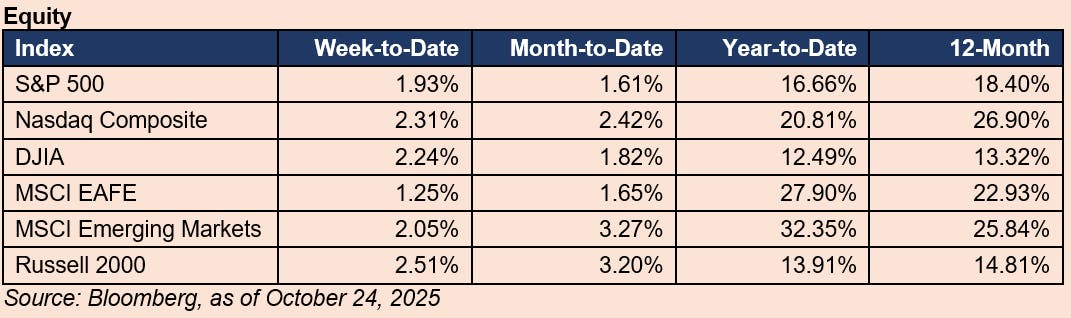
Equities rallied across the board, with Friday being a very strong day. Breadth continues, with the S&P 500, Nasdaq, Dow Jones, and small-cap Russell 2000 closing at all-time highs. Health care, technology, and utilities paced the market, whereas energy, communication services, and financials lagged. The rally was due in part to supportive inflation data that indicated the Fed remains on track to reduce interest rates this week.
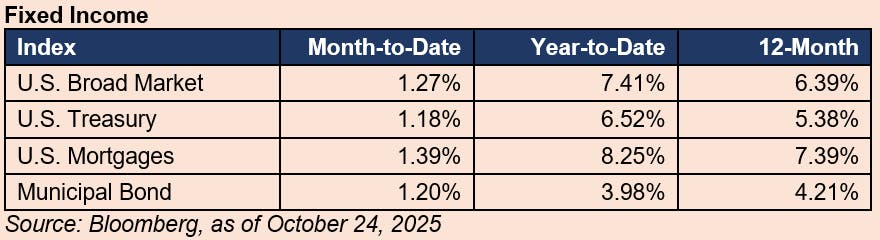
Treasury yields moved moderately lower as supportive inflation data solidified expectations that the Fed will reduce interest rates 25 bps on Wednesday. Attention this week will be on the Fed meeting and Powell’s comments afterward.
The Takeaway
· Equities rallied on strong earnings reports and supportive inflation data. The S&P 500, Nasdaq, Dow Jones, and Russell 2000 reached all-time highs. The increased breadth in the market is a good sign for investors.
· Treasuries rallied modestly, with the yield curve flattening slightly. The market reacted to better-than-anticipated inflation data and the expectation that the Fed will lower rates this week.
Looking Ahead
This week’s focus shifts to consumer confidence, corporate earnings, the Fed meeting, and U.S. and China trade negotiations
· With economic data from the government remains on hold during the shutdown, the biggest piece of economic information this week will be the release of the Conference Board Consumer Confidence Index for October. It’s expected that confidence will again decline.
· It will be a big week for earnings reports from large-cap technology companies, including Alphabet, Amazon, Apple, Meta Platforms, and Microsoft.
· After meeting on October 28–29, the Fed is again expected to lower rates 25 bps. Given that most key economic data has not been reported this month, Powell’s comments after the meeting will take on added importance.
· President Trump and President Xi are scheduled to meet on Thursday, with growing optimism for progress on a trade deal.
Disclosures: This material is intended for informational/educational purposes only and should not be construed as investment advice, a solicitation, or a recommendation to buy or sell any security or investment product. Diversification does not assure a profit or protect against loss in declining markets, and diversification cannot guarantee that any objective or goal will be achieved. Please contact your financial professional for more information specific to your situation.
Bonds are subject to availability and market conditions; some have call features that may affect income. Bond prices and yields are inversely related: when the price goes up, the yield goes down, and vice versa. Market risk is a consideration if sold or redeemed prior to maturity.
Certain sections of this commentary contain forward-looking statements that are based on our reasonable expectations, estimates, projections, and assumptions. Forward-looking statements are not guarantees of future performance and involve certain risks and uncertainties, which are difficult to predict. All indices are unmanaged and are not available for direct investment by the public. Past performance is not indicative of future results. The S&P 500 is based on the average performance of the 500 industrial stocks monitored by Standard & Poor’s. The Nasdaq Composite Index measures the performance of all issues listed in the Nasdaq Stock Market, except for rights, warrants, units, and convertible debentures. The Dow Jones Industrial Average is computed by summing the prices of the stocks of 30 large companies and then dividing that total by an adjusted value, one which has been adjusted over the years to account for the effects of stock splits on the prices of the 30 companies. Dividends are reinvested to reflect the actual performance of the underlying securities. The MSCI EAFE Index is a float-adjusted market capitalization index designed to measure developed market equity performance, excluding the U.S. and Canada. The MSCI Emerging Markets Index is a market capitalization-weighted index composed of companies representative of the market structure of 26 emerging market countries in Europe, Latin America, and the Pacific Basin. The Russell 2000® Index measures the performance of the 2,000 smallest companies in the Russell 3000® Index. The Bloomberg US Aggregate Bond Index is an unmanaged market value-weighted performance benchmark for investment-grade fixed-rate debt issues, including government, corporate, asset-backed, and mortgage-backed securities with maturities of at least one year. The U.S. Treasury Index is based on the auctions of U.S. Treasury bills, or on the U.S. Treasury’s daily yield curve. The Bloomberg US Mortgage Backed Securities (MBS) Index is an unmanaged market value-weighted index of 15- and 30-year fixed-rate securities backed by mortgage pools of the Government National Mortgage Association (GNMA), Federal National Mortgage Association (Fannie Mae), and the Federal Home Loan Mortgage Corporation (FHLMC), and balloon mortgages with fixed-rate coupons. The Bloomberg US Municipal Index includes investment-grade, tax-exempt, and fixed-rate bonds with long-term maturities (greater than 2 years) selected from issues larger than $50 million. One basis point is equal to 1/100th of 1 percent, or 0.01 percent. One basis point (bp) is equal to 1/100th of 1 percent, or 0.01 percent.
###
Zachary Sturdy is located at 307 S Front St, Ste 107 Marquette, MI 49855 and can be reached at (906)226-6056. Securities and advisory services offered through Commonwealth Financial Network®, Member FINRA/SIPC, a Registered Investment Adviser. Fixed insurance products and services are separate from and not offered through Commonwealth Financial Network®.
Authored by the Investment Research team at Commonwealth Financial Network®.
© 2025 Commonwealth Financial Network®