Market Navigator: Week of September 29, 2025
Market Navigator—Week of September 29, 2025
Presented by Zachary R. Sturdy
---
U.S. equities pulled back after a multiweek rally, with late-week gains trimming losses as traders weighed resilient growth data against mixed Federal Reserve (Fed) signals and new tariff headlines. Treasuries weakened and the yield curve flattened on tepid auction demand and reduced bets for aggressive rate cuts. Credit spreads stayed tight despite rising geopolitical tensions.
Quick Hits
1. Beyond the headlines: Second-quarter growth surges, but tariff distortions cloud outlook.
2. Report releases: Durable goods orders rose in August, signaling solid business investment.
3. Financial market data: Profit-taking and tariff concerns tempered risk appetite as defensive stocks gained ahead of key economic updates.
4. Looking ahead: The focus this week shifts to consumer sentiment, manufacturing trends, and labor data.
Keep reading for an in-depth look.
Beyond the Headlines: Second-Quarter Growth Surges, but Tariff Distortions Cloud Outlook
The third estimate from the Bureau of Economic Analysis confirmed that U.S. real GDP expanded at a 3.8 percent annualized rate in the second quarter, rebounding sharply after a –0.6 percent contraction in the first quarter. Consumer spending made the largest positive contribution, and a decline in imports mechanically boosting GDP also played a significant role. Investment and exports were draggers, partially offsetting the gains.
Inflation for core personal consumption expenditures (PCE), which exclude food and energy, held around 2.5 percent, down from previous quarters but still above the Fed’s 2 percent target. The deceleration was mixed: goods inflation cooled but services components remained more resilient. Headline PCE inflation rose about 2.1 percent.
Tariffs Complicate the Picture
Tariff-related dynamics complicate interpretation. Many firms brought imports forward into the first quarter to avoid higher tariffs, inflating quarterly import levels. That import surge reversed in the second quarter, causing a mechanical lift to GDP via import subtraction. In other words, part of second-quarter strength may reflect a trade timing effect and not pure demand growth. If trade tensions escalate or retaliatory measures follow, input costs and supply chains could become another source of inflation and drag.
For investment portfolios and clients, the data reinforces a cautiously positive backdrop—but not without risks. The stronger growth revision gives confidence in economic resilience, which should support exposure to cyclical, growth-oriented sectors. Given continued inflation stickiness and tariff uncertainty, however, strategies should favor companies with pricing power and risk mitigation attributes.
Economic Backdrop Remains Volatile
From a fixed income perspective, the combination of solid growth and still-elevated core inflation may limit how aggressively the Fed can ease interest rates. Markets will watch closely to see whether the central bank leans into patience or pushes for more rate cuts. Intermediate-duration Treasuries could still benefit in a modest easing environment, but inflation surprises or renewed trade-induced cost pressures could make positioning more challenging.
Last quarter’s performance underscores how volatile the economic backdrop remains. Although the rebound shows that the U.S. economy retains momentum, trade distortions, inflation resilience, and policy uncertainty temper the tailwinds. Portfolio construction should stay balanced.
Report Releases—September 22–26, 2025
S&P Global US Composite PMI: September (Tuesday)
The US Composite Purchasing Managers’ Index fell more than expected to 53.6; services PMI fell to 53.9 from 54.5 and manufacturing PMI slipped to 52 from 53.
- Expected/prior month Global US Composite PMI: 53.9/54.6
- Actual Global US Composite PMI: 53.6
New Home Sales: August (Wednesday)
New home sales surprised, with gains exceeding 20 percent versus flat expectations. The 30-year fixed rate mortgage fell 25 basis points (bps) in August.
- Expected/prior month new home sales monthly change: 0.0%/–0.6%
- Actual new home sales monthly change: 20.5%
Durable Goods Orders: August (Thursday)
Headline and core durable goods orders were better than expected to start August, marking four consecutive months with rising core orders. That’s a sign of steady business investment.
- Expected/prior durable goods orders monthly change: –0.3%/–2.7%
- Actual durable goods orders change: +2.9%
- Expected/prior core durable goods orders monthly change: +0.0%/+1.0%
- Actual core durable goods orders change: +0.4%
Existing Home Sales: August (Thursday)
The pace of existing home sales dropped last month due to high costs and limited inventory.
- Expected/prior month existing home sales monthly change: –1.5%/+2.0%
- Actual existing home sales monthly change: –0.2%
The Takeaway
· US Composite PMI eased to 53.6 in September as services and manufacturing activity slowed, missing expectations of 53.9 and signaling a softer expansion.
· August new home sales jumped 20.5 percent versus flat forecasts, helped by a 25 bps drop in 30-year mortgage rates to roughly 6.5 percent–6.75 percent.
Financial Market Data
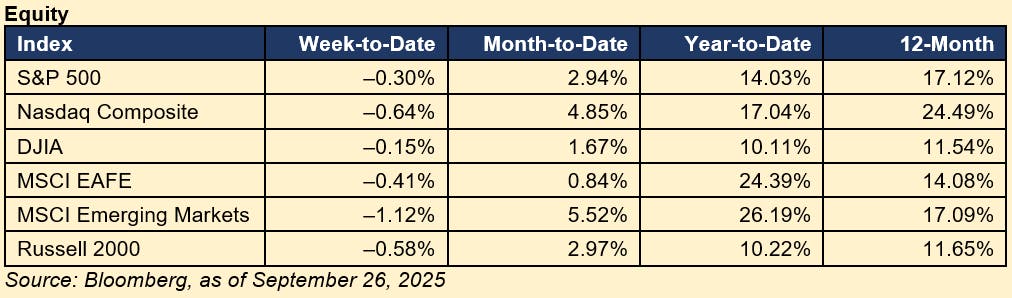
Equities softened after a strong multiweek run, though late-week gains helped trim broader losses. Investors balanced upbeat economic signals with uncertainty over the policy outlook and shifting Fed rhetoric. Sector leadership rotated toward more defensive areas as traders grew cautious. Geopolitical tensions and renewed tariff headlines further encouraged selective profit-taking, prompting a temporary pause in risk appetite and a more measured approach to adding equity exposure as investors await upcoming economic releases and critical policy commentary.
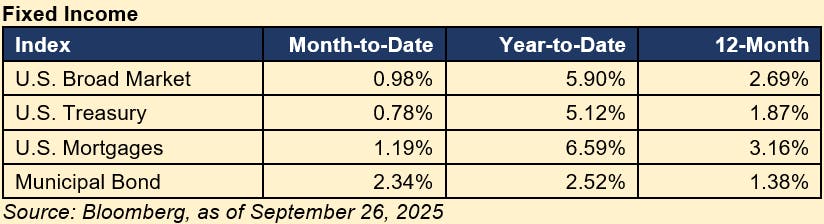
Treasuries weakened as the yield curve flattened, with tepid auction demand underscoring softer foreign participation. Investors pared expectations for multiple near-term rate cuts after solid housing data, firm capital goods orders, and a GDP revision signaled resilient growth. Divergent Fed commentary added uncertainty. Credit markets remained stable and spreads stayed tight despite renewed tariff headlines and rising geopolitical risks.
The Takeaway
· After a multiweek run, equities eased as profit-taking and renewed tariff concerns tempered risk appetite. Defensive sectors saw relative strength ahead of key economic data and policy updates.
· Treasuries softened and the yield curve flattened as resilient growth data and mixed signals from the Fed led investors to trim expectations for near-term interest rate cuts.
Looking Ahead
The week ahead will offer fresh insight into consumer sentiment, manufacturing trends, and the labor market.
· The week kicks off Tuesday with September’s Conference Board Consumer Confidence Index reading, which is expected to show a decline in household optimism.
· On Wednesday, we’ll see the September Institute for Supply Management (ISM) Manufacturing index, with confidence expected to improve slightly but still signal contraction.
· The week wraps on Friday with two reports: September jobs data (economists anticipate a modest hiring gain of roughly 42,000 jobs) and the ISM Services index (expected to hold steady after surging in August).
Disclosures: This material is intended for informational/educational purposes only and should not be construed as investment advice, a solicitation, or a recommendation to buy or sell any security or investment product. Diversification does not assure a profit or protect against loss in declining markets, and diversification cannot guarantee that any objective or goal will be achieved. Please contact your financial professional for more information specific to your situation.
Bonds are subject to availability and market conditions; some have call features that may affect income. Bond prices and yields are inversely related: when the price goes up, the yield goes down, and vice versa. Market risk is a consideration if sold or redeemed prior to maturity.
Certain sections of this commentary contain forward-looking statements that are based on our reasonable expectations, estimates, projections, and assumptions. Forward-looking statements are not guarantees of future performance and involve certain risks and uncertainties, which are difficult to predict. All indices are unmanaged and are not available for direct investment by the public. Past performance is not indicative of future results. The S&P 500 is based on the average performance of the 500 industrial stocks monitored by Standard & Poor’s. The Nasdaq Composite Index measures the performance of all issues listed in the Nasdaq Stock Market, except for rights, warrants, units, and convertible debentures. The Dow Jones Industrial Average is computed by summing the prices of the stocks of 30 large companies and then dividing that total by an adjusted value, one which has been adjusted over the years to account for the effects of stock splits on the prices of the 30 companies. Dividends are reinvested to reflect the actual performance of the underlying securities. The MSCI EAFE Index is a float-adjusted market capitalization index designed to measure developed market equity performance, excluding the U.S. and Canada. The MSCI Emerging Markets Index is a market capitalization-weighted index composed of companies representative of the market structure of 26 emerging market countries in Europe, Latin America, and the Pacific Basin. The Russell 2000® Index measures the performance of the 2,000 smallest companies in the Russell 3000® Index. The Bloomberg US Aggregate Bond Index is an unmanaged market value-weighted performance benchmark for investment-grade fixed-rate debt issues, including government, corporate, asset-backed, and mortgage-backed securities with maturities of at least one year. The U.S. Treasury Index is based on the auctions of U.S. Treasury bills, or on the U.S. Treasury’s daily yield curve. The Bloomberg US Mortgage Backed Securities (MBS) Index is an unmanaged market value-weighted index of 15- and 30-year fixed-rate securities backed by mortgage pools of the Government National Mortgage Association (GNMA), Federal National Mortgage Association (Fannie Mae), and the Federal Home Loan Mortgage Corporation (FHLMC), and balloon mortgages with fixed-rate coupons. The Bloomberg US Municipal Index includes investment-grade, tax-exempt, and fixed-rate bonds with long-term maturities (greater than 2 years) selected from issues larger than $50 million. One basis point is equal to 1/100th of 1 percent, or 0.01 percent. One basis point (bp) is equal to 1/100th of 1 percent, or 0.01 percent.
###
Zachary Sturdy is located at 307 S Front St, Ste 107 Marquette, MI 49855 and can be reached at (906)226-6056. Securities and advisory services offered through Commonwealth Financial Network®, Member FINRA/SIPC, a Registered Investment Adviser. Fixed insurance products and services are separate from and not offered through Commonwealth Financial Network®.
Authored by the Investment Research team at Commonwealth Financial Network®.
© 2025 Commonwealth Financial Network®