Market Navigator—Week of December 1, 2025
Market Navigator—Week of December 1, 2025
Presented by Zachary R. Sturdy
---
U.S. equities rallied across the board during the holiday-shortened week. The small-cap Russell 2000 led the market, growing more than 5 percent. Treasuries also rallied. Investors responded to more favorable commentary about the possibility of another interest rate reduction next week. Federal Reserve (Fed) speakers continued to cite concerns about the health of the labor market.
Quick Hits
1. Beyond the headlines: How important is the holiday shopping season?
2. Report releases: September retail sales and November consumer confidence missed expectations.
3. Financial market data: Equity markets, led by the Russell 2000 and the Nasdaq Composite, rallied across the board.
4. Looking ahead: The ADP employment report for November and the University of Michigan consumer sentiment survey for December are expected this week.
Keep reading for an in-depth look.
Beyond the Headlines: How Important Is the Holiday Shopping Season?
Black Friday, Small Business Saturday, and Cyber Monday jump-start the sprint between Thanksgiving and the end of the year that traditionally makes up the holiday shopping season. In search of deals, consumers often complete a substantial part of their shopping at this time. Consumer spending is critical because it makes up roughly 70 percent of the U.S. economy.
This year, without a clear consensus on the path of the economy, the holiday shopping season may play an even bigger role in determining investor sentiment. Throughout 2025, investors have dealt with headwinds such as trade policy, budget negotiations, and a government shutdown. Yet stocks have rallied, with the S&P 500 up nearly 18 percent. The recently concluded government shutdown caused a delay or cancellation of economic data reports that are important to investors and economists.
Hazy Employment Picture
As the calendar turns to December, the employment market is unclear. The October jobs report was canceled due to data collection issues during the shutdown. The November report, scheduled for release on December 5, has been delayed 11 days to catch up on data collection. Lacking these reports, consumer confidence measures have continued to show a decline in how people feel about the current and future economic outlook.
Against that backdrop, investors will be happy to have real-time data about the health of consumers. That means the spotlight will intensify on any consumer spending information this month. One critical piece of data will be how sales compare with those from prior years. So far, the news has been good; initial indicators based on credit card data show sales up year-over-year. The driver behind these sales is also important. Are retailers offering items for sale because of softer spending trends or excess inventory?
Temporary Impact
Parts of the market will certainly react to any news about sales, and retail stocks will be most affected by the news flow over the next few weeks. Logistic and shipping companies with a significant part of their business tied to holiday sales could also be affected.
In terms of impact on the overall market, though, it’s likely to be temporary. A strong holiday shopping period could buoy investor sentiment and lead to a continuation of the year-end rally. Investors, however, will find other issues to compete for their attention between now and New Year’s Day. One example is next week’s Fed meeting, which will carry a lot of weight as investors decide how to position themselves entering 2026.
Report Releases—November 24–28, 2025
Retail Sales Report: September (Tuesday)
Although retail sales grew in September, they slowed and missed expectations, raising concerns about the health of consumers as holiday shopping season begins.
· Expected/prior month retail sales: 0.4%/0.6%
· Actual retail sales: 0.2%
Producer Price Index (PPI): September (Tuesday)
Producer prices rose in line with expectations, reflecting increases in the cost of energy, food, and core goods.
- Expected/prior month PPI: 0.3%/–0.1%
- Actual PPI: 0.3%
Conference Board Consumer Confidence Index: November (Tuesday)
Consumer confidence missed expectations as present and future concerns persisted.
- Expected/prior month consumer confidence: 93.3/95.5
- Actual consumer confidence: 88.7
The Takeaway
· September retail sales and November consumer confidence missed expectations. Confidence has been under pressure for most of 2025; consumers are concerned about tariffs, the impact of the government shutdown, and their ability to get a job.
· Driven by price increases in energy, food, and core goods, the PPI rose 0.3 percent in September, matching expectations.
Financial Market Data
Equity
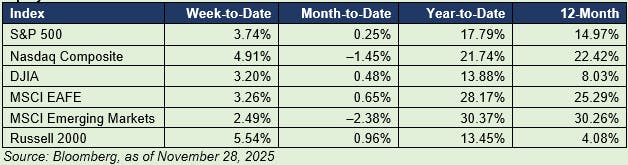
Markets rallied strongly across the board in the holiday-shortened trading week. The small-cap Russell 2000 rose 5.5 percent, the Nasdaq was up nearly 5 percent, and the S&P 500 and Dow Jones each increased more than 3 percent. The rally was driven by a change in market expectations for a rate cut at next week’s Fed meeting. Multiple central bank officials have signaled concerns about the labor market, which was the reason behind interest rate cuts in September and October. All 11 sectors had positive returns, with communication services, consumer discretionary, and technology leading the way.
Fixed Income
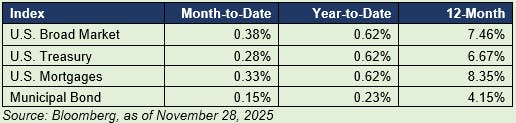
The bond market also responded favorably to the dovish tone from Fed speakers. Treasuries were firmer across the curve, with the yield on the 10-year Treasury dropping back to nearly 4 percent.
The Takeaway
· Equities, paced by communications services, consumer discretionary, and technology sectors, rallied across the board in the holiday-shortened trading week. The rebound was tied to more dovish comments from Fed members in advance of their meeting next week.
· Treasuries were firmer; yields dropped across the curve. This rally was also driven by Fed commentary that indicated the potential for a rate cut next week. Yields for the 10-year approached 4 percent, approaching the low from the past month.
Looking Ahead
This week will be highlighted by the ADP employment report for November, and preliminary University of Michigan consumer sentiment for December. Fed Chair Jerome Powell is also expected to speak.
· On Wednesday, we expect the ADP employment report. This will be the last look at the employment market before next week’s Fed meeting.
· On Friday, we’ll see the preliminary University of Michigan consumer sentiment survey for December.
Disclosures: This material is intended for informational/educational purposes only and should not be construed as investment advice, a solicitation, or a recommendation to buy or sell any security or investment product. Diversification does not assure a profit or protect against loss in declining markets, and diversification cannot guarantee that any objective or goal will be achieved. Please contact your financial professional for more information specific to your situation.
Bonds are subject to availability and market conditions; some have call features that may affect income. Bond prices and yields are inversely related: when the price goes up, the yield goes down, and vice versa. Market risk is a consideration if sold or redeemed prior to maturity.
Certain sections of this commentary contain forward-looking statements that are based on our reasonable expectations, estimates, projections, and assumptions. Forward-looking statements are not guarantees of future performance and involve certain risks and uncertainties, which are difficult to predict. All indices are unmanaged and are not available for direct investment by the public. Past performance is not indicative of future results. The S&P 500 is based on the average performance of the 500 industrial stocks monitored by Standard & Poor’s. The Nasdaq Composite Index measures the performance of all issues listed in the Nasdaq Stock Market, except for rights, warrants, units, and convertible debentures. The Dow Jones Industrial Average is computed by summing the prices of the stocks of 30 large companies and then dividing that total by an adjusted value, one which has been adjusted over the years to account for the effects of stock splits on the prices of the 30 companies. Dividends are reinvested to reflect the actual performance of the underlying securities. The MSCI EAFE Index is a float-adjusted market capitalization index designed to measure developed market equity performance, excluding the U.S. and Canada. The MSCI Emerging Markets Index is a market capitalization-weighted index composed of companies representative of the market structure of 26 emerging market countries in Europe, Latin America, and the Pacific Basin. The Russell 2000® Index measures the performance of the 2,000 smallest companies in the Russell 3000® Index. The Bloomberg US Aggregate Bond Index is an unmanaged market value-weighted performance benchmark for investment-grade fixed-rate debt issues, including government, corporate, asset-backed, and mortgage-backed securities with maturities of at least one year. The U.S. Treasury Index is based on the auctions of U.S. Treasury bills, or on the U.S. Treasury’s daily yield curve. The Bloomberg US Mortgage Backed Securities (MBS) Index is an unmanaged market value-weighted index of 15- and 30-year fixed-rate securities backed by mortgage pools of the Government National Mortgage Association (GNMA), Federal National Mortgage Association (Fannie Mae), and the Federal Home Loan Mortgage Corporation (FHLMC), and balloon mortgages with fixed-rate coupons. The Bloomberg US Municipal Index includes investment-grade, tax-exempt, and fixed-rate bonds with long-term maturities (greater than 2 years) selected from issues larger than $50 million. One basis point is equal to 1/100th of 1 percent, or 0.01 percent. One basis point (bp) is equal to 1/100th of 1 percent, or 0.01 percent.
###
Zachary Sturdy is located at 307 S Front St, Ste 107 Marquette, MI 49855 and can be reached at (906)226-6056. Securities and advisory services offered through Commonwealth Financial Network®, Member FINRA/SIPC, a Registered Investment Adviser. Fixed insurance products and services are separate from and not offered through Commonwealth Financial Network®.
Authored by the Investment Research team at Commonwealth Financial Network®.
© 2025 Commonwealth Financial Network®