Market Navigator—Week of September 22, 2025
Market Navigator—Week of September 22, 2025
Presented by Zachary R. Sturdy
---
U.S. equities climbed as AI enthusiasm and strong corporate guidance lifted mega-cap technology and semiconductor stocks, with Nvidia and Alphabet leading the way. Retail sales beat expectations and jobless claims fell, easing stagflation concerns. Treasuries sold off and the yield curve steepened as stronger data tempered aggressive Federal Reserve (Fed) rate cut bets.
Quick Hits
1. Beyond the headlines: Powell signals careful shift toward neutral as labor market softens.
2. Report releases: The FOMC lowered the range for the federal funds rate 25 basis points (bps).
3. Financial market data: AI optimism and upbeat guidance lifted mega-cap tech. Weak housing data weighed on builders.
4. Looking ahead: The focus this week turns to business activity and housing metrics.
Keep reading for an in-depth look.
Beyond the Headlines: Powell Signals Careful Shift Toward Neutral as Labor Market Softens
Last week’s Federal Open Market Committee (FOMC) meeting delivered a rate cut of 25 bps and a more dovish Summary of Economic Projections (SEP), with the median “dot” now implying roughly 75 bps of easing by year-end and a slightly lower policy path through 2026. Fed Chair Jerome Powell emphasized that policy is “not on a preset course,” framing the move as a “risk management” step to address a labor market that has cooled sharply. Payroll gains have slowed to an average of just 29,000 per month over the past three months and the unemployment rate has edged up to 4.3 percent, a notable shift from the robust job creation earlier in the year. Powell highlighted what he called a “curious balance,” where both labor supply and demand have fallen, an uncommon pattern that raises downside risks to employment even as inflation remains above the Fed’s 2 percent target.
Fed Remains Committed to Dual Mandate
Growth estimates for 2025 were nudged slightly higher and inflation projections remain somewhat elevated, with core personal consumption expenditures (PCE) expected to trend toward 2 percent only gradually. Powell acknowledged that shorter-term inflation expectations have risen in response to tariff news but stressed that longer-term expectations remain firmly anchored near 2 percent. He reiterated that the central bank remains committed to its dual mandate of maximum employment and stable prices even in the face of these unusual crosscurrents.
The policy debate also reflected notable internal dynamics. Ten of nineteen FOMC participants projected two or more additional cuts this year and a newly appointed governor dissented in favor of a 50 bps cut, underscoring the range of views. Powell’s term ends in early 2026, and the arrival of governor Stephen Miran, who maintains ties to the White House, has prompted fresh questions about the Fed’s independence. Powell firmly defended the institution’s long-standing culture of nonpartisanship and data-driven decision-making, noting that arguments within the committee must be grounded in economic analysis, not politics.
Balance Between Growth and Defense
For equities, a steady glide path of rate cuts typically supports valuations and risk appetite, particularly in rate-sensitive sectors such as small-caps, housing, and high-growth technology; however, the split within the FOMC, recent changes in Fed membership, and Powell’s approaching term limit argue for maintaining balance between growth-oriented and defensive exposures.
In fixed income, the combination of lower projected policy rates and a single dissent reinforces demand for duration, especially in intermediate Treasuries. Investors should remain alert to the possibility of a slower easing pace or a renewed inflation flare-up. Diversification and flexibility remain critical as the central bank navigates the delicate balance between a softening labor market and lingering price pressures.
Report Releases—September 15–19, 2025
Retail Sales: August (Tuesday)
Retail sales beat expectations last month, driven in part by a surge in online sales.
- Expected/prior month retail sales monthly change: +0.2%/+0.6%
- Actual retail sales monthly change: +0.6%
NAHB Housing Market Index: September (Tuesday)
Confidence remained challenged as home builders cited high prices and a lack of prospective homebuyers as industry headwinds.
- Expected/prior month NAHB Housing Market Index: 33/32
- Actual NAHB Housing Market Index: 32
Housing Starts and Building Permits: August (Wednesday)
Housing starts and building permits both fell more than expected last month.
- Expected/prior month housing starts monthly change: +3.4%/–4.4%
- Actual housing starts monthly change: –8.5%
- Expected/prior month building permits monthly change: +0.6%/–2.2%
- Actual building permits monthly change: –3.7%
FOMC Rate Decision: September (Wednesday)
The FOMC lowered the range for the federal funds rate 25 bps after its meeting last week.
- Expected/prior federal funds rate upper limit: 4.25%/4.50%
- Actual federal funds rate upper limit: 4.25%
The Takeaway
· Retail sales climbed 0.6 percent in August, beating the 0.2 percent forecast, as robust online demand fueled a second consecutive monthly gain.
· The Fed cut the federal funds rate upper limit 25 bps to 4.25 percent in September; housing starts and permits fell sharply.
Financial Market Data
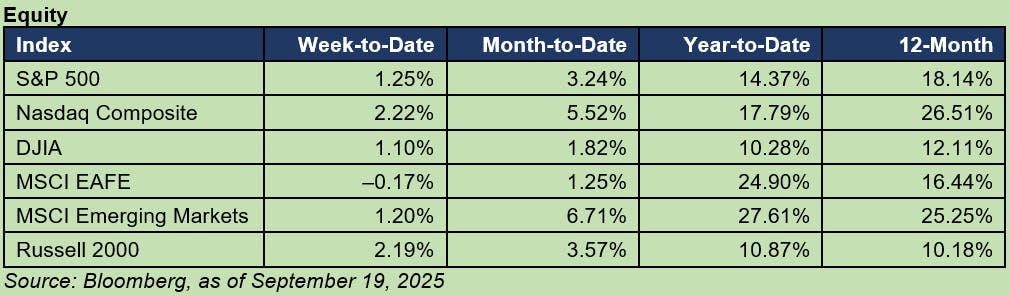
U.S. equities posted broad gains as AI enthusiasm and upbeat corporate guidance fueled strong moves in mega-cap technology, semiconductors, and China internet names. Retail sales beat expectations and jobless claims fell, easing stagflation worries. The Fed’s updated dot plot pointed to 75 bps of rate cuts this year, though Powell stressed last week’s 25 bps move was a “risk-management” cut and pushed back on a larger reduction. Nvidia rallied on news of a $5 billion Intel investment and optimism around its AI partnership, and Alphabet reached a $3 trillion market capitalization on Gemini and Nano Banana updates. Home builders lagged amid weaker August housing data.
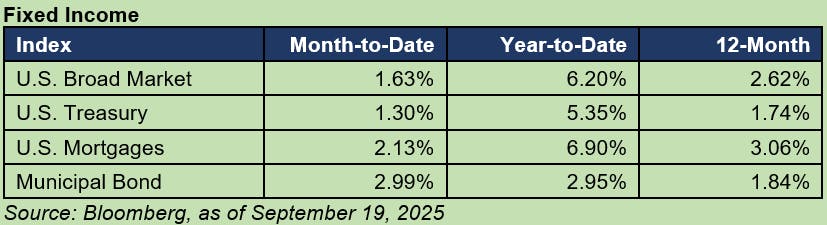
Treasuries sold off as the yield curve steepened, with yields rising after the Fed’s 25 bps cut and a more dovish SEP projecting 75 bps of total easing this year. Powell labeled the move “risk management” and pushed back on a larger cut, tempering aggressive-easing bets. Stronger retail sales and lower jobless claims further reduced urgency for rapid rate reductions, and August housing data highlighted soft starts and permits. Credit markets remained firm with tight spreads, signaling steady risk appetite despite lingering trade tensions and geopolitical uncertainty. The dollar inched higher and gold posted modest gains, reflecting balanced risk sentiment.
The Takeaway
· Equities advanced as AI optimism and upbeat guidance buoyed mega-cap technology and semiconductors, though Powell’s cautious tone and weaker housing data tempered enthusiasm.
· Treasuries weakened and the yield curve steepened as stronger retail sales and falling jobless claims reduced urgency for rapid Fed easing.
Looking Ahead
This week’s calendar features fresh reads on business activity and key housing indicators that will guide views on economic momentum.
· The week kicks off Tuesday with the September preliminary S&P Global US Composite PMI, offering an early look at business conditions across manufacturing and services.
· On Wednesday, we’ll receive another gauge of housing demand with August new home sales, which are expected to be near 655,000.
· Finally, on Thursday, we expect August data on durable goods orders, which are expected to decline for a second month, and existing home sales, which are anticipated to slow after July’s rebound.
Disclosures: This material is intended for informational/educational purposes only and should not be construed as investment advice, a solicitation, or a recommendation to buy or sell any security or investment product. Diversification does not assure a profit or protect against loss in declining markets, and diversification cannot guarantee that any objective or goal will be achieved. Please contact your financial professional for more information specific to your situation.
Bonds are subject to availability and market conditions; some have call features that may affect income. Bond prices and yields are inversely related: when the price goes up, the yield goes down, and vice versa. Market risk is a consideration if sold or redeemed prior to maturity.
Certain sections of this commentary contain forward-looking statements that are based on our reasonable expectations, estimates, projections, and assumptions. Forward-looking statements are not guarantees of future performance and involve certain risks and uncertainties, which are difficult to predict. All indices are unmanaged and are not available for direct investment by the public. Past performance is not indicative of future results. The S&P 500 is based on the average performance of the 500 industrial stocks monitored by Standard & Poor’s. The Nasdaq Composite Index measures the performance of all issues listed in the Nasdaq Stock Market, except for rights, warrants, units, and convertible debentures. The Dow Jones Industrial Average is computed by summing the prices of the stocks of 30 large companies and then dividing that total by an adjusted value, one which has been adjusted over the years to account for the effects of stock splits on the prices of the 30 companies. Dividends are reinvested to reflect the actual performance of the underlying securities. The MSCI EAFE Index is a float-adjusted market capitalization index designed to measure developed market equity performance, excluding the U.S. and Canada. The MSCI Emerging Markets Index is a market capitalization-weighted index composed of companies representative of the market structure of 26 emerging market countries in Europe, Latin America, and the Pacific Basin. The Russell 2000® Index measures the performance of the 2,000 smallest companies in the Russell 3000® Index. The Bloomberg US Aggregate Bond Index is an unmanaged market value-weighted performance benchmark for investment-grade fixed-rate debt issues, including government, corporate, asset-backed, and mortgage-backed securities with maturities of at least one year. The U.S. Treasury Index is based on the auctions of U.S. Treasury bills, or on the U.S. Treasury’s daily yield curve. The Bloomberg US Mortgage Backed Securities (MBS) Index is an unmanaged market value-weighted index of 15- and 30-year fixed-rate securities backed by mortgage pools of the Government National Mortgage Association (GNMA), Federal National Mortgage Association (Fannie Mae), and the Federal Home Loan Mortgage Corporation (FHLMC), and balloon mortgages with fixed-rate coupons. The Bloomberg US Municipal Index includes investment-grade, tax-exempt, and fixed-rate bonds with long-term maturities (greater than 2 years) selected from issues larger than $50 million. One basis point is equal to 1/100th of 1 percent, or 0.01 percent. One basis point (bp) is equal to 1/100th of 1 percent, or 0.01 percent.
###
Zachary Sturdy is located at 307 S Front St, Ste 107 Marquette, MI 49855 and can be reached at (906)226-6056. Securities and advisory services offered through Commonwealth Financial Network®, Member FINRA/SIPC, a Registered Investment Adviser. Fixed insurance products and services are separate from and not offered through Commonwealth Financial Network®.
Authored by the Investment Research team at Commonwealth Financial Network®.
© 2025 Commonwealth Financial Network®