Market Navigator—Week of September 15, 2025
Market Navigator—Week of September 15, 2025
Presented by Zachary R. Sturdy
---
With technology leading on strong, AI-driven results, U.S. equities rose. Investors looked ahead to this week’s Federal Open Market Committee (FOMC) meeting, with an interest rate cut of 25 basis points (bps) fully priced in. Treasuries firmed and the yield curve flattened as weak labor data and mixed inflation reinforced expectations for further policy easing.
Quick Hits
1. Beyond the headlines: Labor data revisions raise prospect of deeper Federal Reserve (Fed) cuts.
2. Report releases: Consumer inflation accelerated last month; prices rose at their fastest pace in seven months.
3. Financial market data: Tech led the way on strong AI results but defensive stocks lagged on soft labor data.
4. Looking ahead: The focus this week will shift to retail spending, housing data, and Fed policy.
Keep reading for an in-depth look.
Beyond the Headlines: Labor Data Revisions Raise Prospect of Deeper Fed Cuts
September’s policy debate is being reshaped by fresh evidence that the U.S. labor market is weaker than previously believed. The Bureau of Labor Statistics’ annual benchmark revisions revealed a sharp 911,000 downward adjustment to job growth from April 2024 through March 2025, highlighting that hiring slowed far more dramatically than earlier data suggested. Fed Chair Jerome Powell acknowledged the revisions in his remarks at the Jackson Hole Economic Policy Symposium last month, noting that monthly job growth has decelerated from an average of 168,000 in 2024 to roughly 35,000 over the past three months.
This abrupt cooling creates what Powell called a curious balance; the unemployment rate remains low at 4.3 percent and broadly stable but payroll growth has slowed to a crawl. The Fed chair emphasized the difficulty in separating structural shifts, such as immigration patterns and demographic trends, from cyclical weakness in labor demand. His comments underscored the central bank’s growing concern that downside risks to employment may be emerging even as inflation, though largely contained, has not fully receded.
Markets Expect Rate Easing
Markets interpreted Powell’s tone as a clear signal that a rate cut this month is highly likely. Futures now fully expect a reduction of 25 bps this week and imply additional easing into year-end. Some analysts believe the depth of the labor revision could push the Fed toward a more aggressive path if incoming data continues to show softening employment and modest inflation pressures.
For equities, easier policy typically supports valuations and risk appetite, particularly in rate-sensitive areas such as small-caps and cyclical sectors. Yet uncertainty around the accuracy of labor data raises the prospect of heightened volatility. Growth stocks may continue to benefit from lower discount rates, but any resurgence in inflation or a misstep by the Fed could quickly reverse sentiment. Defensive sectors, though lagging recently, could regain appeal if market turbulence rises.
In fixed income, the revisions and Powell’s remarks reinforced demand for duration. The Treasury yield curve has already flattened as investors anticipate cuts, and a faster-than-expected pace of easing could trigger accelerated steepening if short-term rates fall sharply and long yields stabilize on lingering inflation risk. Credit spreads remain tight, reflecting corporate resilience, but limited cushion remains should growth soften further.
Flexibility and Diversity Is Critical
For investors, the message is twofold: policy is turning more accommodative but the path ahead may be uneven. Advisors should encourage clients to maintain diversified exposure, balancing rate-sensitive assets and high-quality credit with hedges against potential inflation flare-ups. The combination of data uncertainty and shifting Fed priorities argues for flexibility as markets adjust to a labor market that is proving to be weaker than earlier reports implied.
Report Releases—September 8–12, 2025
National Federation of Independent Business (NFIB) Small Business Optimism Index: August (Tuesday)
The NFIB Small Business Optimism Index rose 0.5 points to 100.8, nearly 3 points above the 52-year average of 98. Of the 10 index components, 4 increased, 4 decreased, and 2 were unchanged.
Producer Price Index (PPI): August (Wednesday)
Producer inflation was well below expectations after surging in July.
- Prior monthly PPI/core PPI growth: +0.7%/+0.7%
- Expected monthly PPI/core PPI growth: +0.3%/+0.3%
- Actual monthly PPI/core PPI growth: –0.1%/–0.1%
- Prior year-over-year PPI/core PPI growth: +3.1%/+3.4%
- Expected year-over-year PPI/core PPI growth: +3.3%/+3.5%
- Actual year-over-year PPI/core PPI growth: +2.6%/+2.8%
Consumer Price Index (CPI): August (Thursday) Headline consumer inflation continued to rise in August, as prices increased by 2.9 percent on a year-on-year basis for the month.
- Prior monthly CPI/core CPI growth: +0.2%/+0.3%
- Expected monthly CPI/core CPI growth: +0.3%/+0.3%
- Actual monthly CPI/core CPI growth: +0.4%/+0.3%
- Prior year-over-year CPI/core CPI growth: +2.7%/+3.1%
- Expected year-over-year CPI/core CPI growth: +2.9%/+3.1%
- Actual year-over-year CPI/core CPI growth: +2.9%/+3.1%
University of Michigan Consumer Sentiment Survey: September (Friday)
Consumer sentiment fell to start September, due in part to rising long-term inflation expectations.
- Expected/prior month sentiment: 58.0/58.2
- Actual sentiment: 55.4
The Takeaway
· The NFIB Small Business Optimism Index edged up in August and is roughly three points higher than its long-term average.
· Headline and core producer prices unexpectedly fell 0.1 percent, trimming year-over-year gains to 2.6 percent and 2.8 percent, respectively.
Financial Market Data
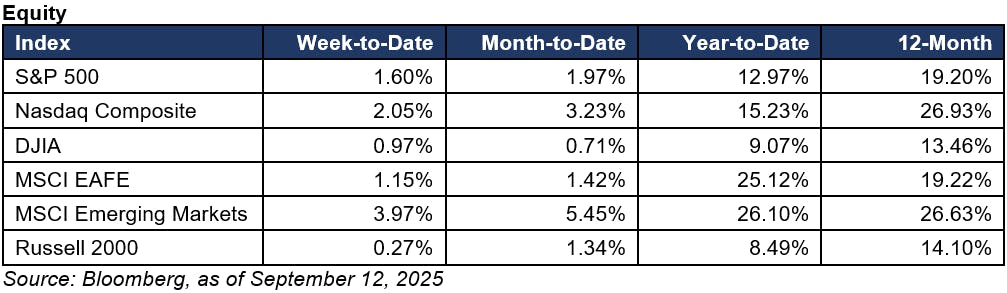
U.S. equities advanced, with technology leading gains on strong, AI-driven results from Oracle and solid demand signals from other large-cap tech stocks. Breadth was negative; the equal-weighted S&P 500 trailed and defensive groups such as consumer staples and medical devices lagged. Investors focused on this week’s FOMC meeting, with a rate cut of 25 bps fully priced in and additional easing expected by year-end. Labor data showed a sizable downward payroll revision and jobless claims at their highest level since 2021, reinforcing a softer labor backdrop amid mixed inflation readings.
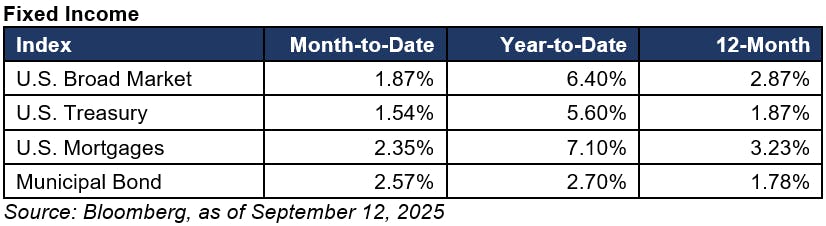
Treasuries firmed as investors positioned for this week’s FOMC meeting amid growing signs of labor market softening. A downward revision of nearly 1 million to payrolls boosted demand for duration and supported a flatter yield curve. Inflation data was mixed; headline CPI was slightly hot but core readings were steady and August PPI cooled. Markets expect a rate cut of 25 bps this week and additional easing by year-end. Credit spreads remained tight, reflecting steady risk appetite even as tariff headlines and weaker sentiment surveys added to growth uncertainty.
The Takeaway
· Equities gained as strong, AI-driven tech earnings lifted sentiment. Investors looked to this week’s Fed meeting with a rate cut fully expected.
· Treasuries firmed and the yield curve flattened as softer labor data and mixed inflation reinforced expectations for policy easing by year-end.
Looking Ahead
This week, we expect critical updates on consumer spending, housing activity, and Fed policy that will shape the outlook for growth and interest rates.
· On Tuesday, retail sales data for August is expected to show solid growth. We also expect the release of September’s NAHB/Wells Fargo Housing Market Index, which remains in contraction.
· On Wednesday, we expect data on August housing starts and building permits, with forecasts calling for mixed results. The day will conclude with the September FOMC meeting, at which markets widely expect a rate cut of 25 bps.
Disclosures: This material is intended for informational/educational purposes only and should not be construed as investment advice, a solicitation, or a recommendation to buy or sell any security or investment product. Diversification does not assure a profit or protect against loss in declining markets, and diversification cannot guarantee that any objective or goal will be achieved. Please contact your financial professional for more information specific to your situation.
Bonds are subject to availability and market conditions; some have call features that may affect income. Bond prices and yields are inversely related: when the price goes up, the yield goes down, and vice versa. Market risk is a consideration if sold or redeemed prior to maturity.
Certain sections of this commentary contain forward-looking statements that are based on our reasonable expectations, estimates, projections, and assumptions. Forward-looking statements are not guarantees of future performance and involve certain risks and uncertainties, which are difficult to predict. All indices are unmanaged and are not available for direct investment by the public. Past performance is not indicative of future results. The S&P 500 is based on the average performance of the 500 industrial stocks monitored by Standard & Poor’s. The Nasdaq Composite Index measures the performance of all issues listed in the Nasdaq Stock Market, except for rights, warrants, units, and convertible debentures. The Dow Jones Industrial Average is computed by summing the prices of the stocks of 30 large companies and then dividing that total by an adjusted value, one which has been adjusted over the years to account for the effects of stock splits on the prices of the 30 companies. Dividends are reinvested to reflect the actual performance of the underlying securities. The MSCI EAFE Index is a float-adjusted market capitalization index designed to measure developed market equity performance, excluding the U.S. and Canada. The MSCI Emerging Markets Index is a market capitalization-weighted index composed of companies representative of the market structure of 26 emerging market countries in Europe, Latin America, and the Pacific Basin. The Russell 2000® Index measures the performance of the 2,000 smallest companies in the Russell 3000® Index. The Bloomberg US Aggregate Bond Index is an unmanaged market value-weighted performance benchmark for investment-grade fixed-rate debt issues, including government, corporate, asset-backed, and mortgage-backed securities with maturities of at least one year. The U.S. Treasury Index is based on the auctions of U.S. Treasury bills, or on the U.S. Treasury’s daily yield curve. The Bloomberg US Mortgage Backed Securities (MBS) Index is an unmanaged market value-weighted index of 15- and 30-year fixed-rate securities backed by mortgage pools of the Government National Mortgage Association (GNMA), Federal National Mortgage Association (Fannie Mae), and the Federal Home Loan Mortgage Corporation (FHLMC), and balloon mortgages with fixed-rate coupons. The Bloomberg US Municipal Index includes investment-grade, tax-exempt, and fixed-rate bonds with long-term maturities (greater than 2 years) selected from issues larger than $50 million. One basis point is equal to 1/100th of 1 percent, or 0.01 percent. One basis point (bp) is equal to 1/100th of 1 percent, or 0.01 percent.
###
Securities and advisory services offered through Commonwealth Financial Network®, Member FINRA/SIPC, a Registered Investment Adviser. Fixed insurance products and services are separate from and not offered through Commonwealth Financial Network®.
Authored by the Investment Research team at Commonwealth Financial Network®.
© 2025 Commonwealth Financial Network®