Market Navigator—Week of September 2, 2025
Market Navigator—Week of September 2, 2025
Presented by Zachary R. Sturdy
---
U.S. equities were mostly lower. Small-caps and cyclical groups outperformed but defensive stocks lagged. Retail earnings pointed to resilient consumer spending at the higher end, but tariff headwinds and Federal Reserve (Fed) independence concerns pressured sentiment. Treasuries were mixed, with the yield curve steepening, as expectations for a rate cut this month remained intact.
Quick Hits
1. Beyond the headlines: Wall Street faces rate cut expectations and softer labor data.
2. Report releases: Durable goods orders were better than expected in July.
3. Financial market data: Small-caps and cyclicals outperformed, but defensive stocks and
big tech lagged.
4. Looking ahead: The focus will shift to manufacturing, services, construction spending, and August employment data.
Beyond the Headlines: Wall Street Faces Rate Cut Expectations and Softer
Labor Data
After a summer of falling volatility, Wall Street entered September against a backdrop of softer employment data, renewed debate over Fed independence, and mounting expectations for an interest rate cut. In theory, looser policy should support valuations and risk appetite, but it also raises the chances that inflation concerns could reemerge.
Recent economic releases painted a mixed but resilient picture. Job creation has slowed, with labor market momentum cooling even as wage growth steadied. Consumer spending remained healthy among higher-income households, though tariff pressures weighed on lower-income segments. Meanwhile, the Manufacturing Purchasing Managers Index (PMI) jumped to 53.3 in August, its highest level in three years, and the Services PMI, at 55.7, is near three-year highs—signaling solid momentum in goods and services. A revised GDP confirmed steady but moderating growth, reinforcing that the Fed faces a delicate balancing act between downside risks to employment and upside risks to inflation.
Renewed Focus on 2 Percent Inflation Target
At the Jackson Hole Economic Policy Symposium last month, Fed Chair Jerome Powell underscored a renewed focus on the central bank’s 2 percent inflation target, moving away from the average inflation targeting adopted after the Covid-19 pandemic. This shift reinforced the Fed’s commitment to restoring price stability, though markets remain sensitive to political developments and questions over central bank independence. Tariff-driven pressures further complicate the policy outlook, raising the risk that inflation may be stickier than policymakers anticipate.
Markets have largely priced in a rate cut this month, with futures implying near-certain odds of a drop of 25 basis points (bps). Yet, the risk is that easing coincides with stronger near-term growth signals, particularly if robust PMI readings suggest the economy remains more resilient than expected. History shows that when policy pivots occur in the face of mixed data, initial optimism can quickly give way to volatility if inflation persists.
Divergence Among Equities Could Occur
For equities, the setup points to divergence across styles and sectors. Cyclicals and small-caps, which benefit most from lower borrowing costs, may see continued support, especially given firmer growth signals. At the same time, richly valued growth stocks could remain vulnerable if inflation concerns reemerge, and defensive stocks may regain interest if volatility picks up from subdued summer levels.
In fixed income, front-end Treasury yields have already eased in anticipation of rate cuts, steepening the curve. If easing materializes, extending duration may offer tactical upside, though heavy Treasury issuance and tariff-linked inflation risks could cap declines in long-term yields. Credit spreads remain near cycle highs, reflecting confidence in corporate fundamentals, but leave limited buffer if growth
slows unexpectedly.
After the summer lull, the combination of softer labor data, strong PMI readings, Powell’s renewed
2 percent inflation focus, and the prospect of near-term easing creates opportunity and risk on Wall Street. Investors face an environment in which policy flexibility could support assets, but inflation and political uncertainty may keep volatility elevated into early 2026. Maintaining diversification and balancing
rate-sensitive exposures with inflation hedges remains the most prudent course.
Report Releases—August 25–29, 2025
New Home Sales: July (Monday)
New home sales exceeded expectations but were slightly lower than they were in June.
- Expected/prior month new home sales: 632,000/656,000
- Actual new home sales: 652,000
Durable Goods Orders: July (Tuesday)
Headline and core durable goods orders were better than expected to start July.
- Expected/prior durable goods orders monthly change: –3.8%/–9.4%
- Actual durable goods orders change: –2.8%
- Expected/prior core durable goods orders monthly change: +0.2%/+0.3%
- Actual core durable goods orders change: +1.1%
Conference Board Consumer Confidence Index: August (Wednesday)
Consumer confidence fell less than expected in August, as improving consumer views on current economic conditions supported sentiment.
- Expected/prior month consumer confidence: 96.5/98.7
- Actual consumer confidence: 97.4
Personal Income and Spending: July (Thursday)
Personal income and spending were in line with expectations for July and were slightly higher than their June levels.
- Expected/prior personal income monthly change: +0.4%/+0.3%
- Actual personal income change: +0.4%
- Expected/prior personal spending monthly change: +0.5%/+0.4%
- Actual personal spending change: +0.5%
The Takeaway
· July new home sales topped expectations at 652,000 as easing mortgage rates provided support for housing demand.
· Durable goods orders fell a smaller-than-expected 2.8 percent in July, and core orders rose
1.1 percent—well above forecasts—signaling that underlying business investment remained firm.
Financial Market Data
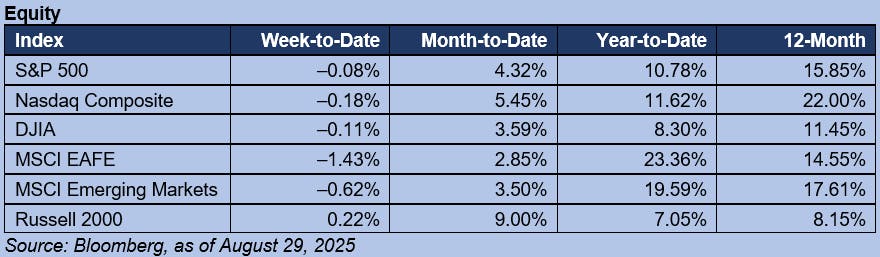
Equities were mostly lower, though small-caps outperformed on the strength of energy, financials, travel, and commodity-linked stocks. Defensive stocks, such as utilities, staples, health care, and home builders, lagged. Big tech traded mixed amid scrutiny of AI earnings. Retail results underscored resilient premium consumer spending, though tariff headwinds weighed on lower-income segments. Sentiment was pressured by concerns over Fed independence, trade uncertainty, and labor market cooling, which was partially offset by stronger GDP revisions and stable consumption. Overall, breadth improved outside defensives, with cyclicals and rate-sensitive groups outperforming, leaving equities consolidating ahead of next week’s Institute for Supply Management (ISM) and payroll releases.
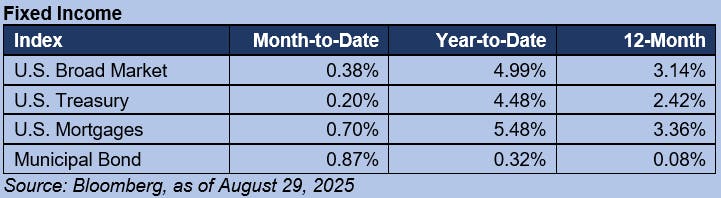
Treasuries were mixed as the yield curve steepened, with front-end yields little changed and longer maturities drifting higher. Markets weighed softer labor signals, tariff-driven inflation risks, and renewed questions about Fed independence against in-line personal consumption data and firmer growth revisions. Rate cut expectations for September remained intact, though policy uncertainty tempered conviction. Credit markets were stable with spreads near cycle highs, reflecting resilient risk appetite despite political noise and trade volatility. Global sovereigns remained under pressure, led by weaker European bonds, and gold’s surge underscored persistent demand for hedges amid an uncertain policy and geopolitical backdrop.
The Takeaway
· Equities were mostly lower, though small-caps, energy, financials, and travel outperformed. Defensive stocks and big tech lagged amid AI scrutiny, tariff headwinds, and Fed
independence concerns.
· Treasuries were mixed, with the curve steepening as longer yields rose. September rate cut expectations held firm despite labor softness, trade risks, and policy uncertainty.
Looking Ahead
The week ahead will highlight activity and sentiment across manufacturing, services, and labor markets. Investors will watch for signs of stabilization in growth and the potential implications for Fed policy.
· The week kicks off Tuesday with last month’s ISM Manufacturing data, which is expected to improve slightly but remain in contraction. Construction spending is seen as flat.
· On Thursday, ISM Services data is forecast to tick higher after slumping in July.
· The week wraps on Friday with the August employment report, which is expected to show modest job gains of around 80,000.
Disclosures: This material is intended for informational/educational purposes only and should not be construed as investment advice, a solicitation, or a recommendation to buy or sell any security or investment product. Diversification does not assure a profit or protect against loss in declining markets, and diversification cannot guarantee that any objective or goal will be achieved. Please contact your financial professional for more information specific to your situation.
Bonds are subject to availability and market conditions; some have call features that may affect income. Bond prices and yields are inversely related: when the price goes up, the yield goes down, and vice versa. Market risk is a consideration if sold or redeemed prior to maturity.
Certain sections of this commentary contain forward-looking statements that are based on our reasonable expectations, estimates, projections, and assumptions. Forward-looking statements are not guarantees of future performance and involve certain risks and uncertainties, which are difficult to predict. All indices are unmanaged and are not available for direct investment by the public. Past performance is not indicative of future results. The S&P 500 is based on the average performance of the 500 industrial stocks monitored by Standard & Poor’s. The Nasdaq Composite Index measures the performance of all issues listed in the Nasdaq Stock Market, except for rights, warrants, units, and convertible debentures. The Dow Jones Industrial Average is computed by summing the prices of the stocks of 30 large companies and then dividing that total by an adjusted value, one which has been adjusted over the years to account for the effects of stock splits on the prices of the 30 companies. Dividends are reinvested to reflect the actual performance of the underlying securities. The MSCI EAFE Index is a float-adjusted market capitalization index designed to measure developed market equity performance, excluding the U.S. and Canada. The MSCI Emerging Markets Index is a market capitalization-weighted index composed of companies representative of the market structure of 26 emerging market countries in Europe, Latin America, and the Pacific Basin. The Russell 2000® Index measures the performance of the 2,000 smallest companies in the Russell 3000® Index. The Bloomberg US Aggregate Bond Index is an unmanaged market value-weighted performance benchmark for investment-grade fixed-rate debt issues, including government, corporate, asset-backed, and mortgage-backed securities with maturities of at least one year. The U.S. Treasury Index is based on the auctions of U.S. Treasury bills, or on the U.S. Treasury’s daily yield curve. The Bloomberg US Mortgage Backed Securities (MBS) Index is an unmanaged market value-weighted index of 15- and 30-year fixed-rate securities backed by mortgage pools of the Government National Mortgage Association (GNMA), Federal National Mortgage Association (Fannie Mae), and the Federal Home Loan Mortgage Corporation (FHLMC), and balloon mortgages with fixed-rate coupons. The Bloomberg US Municipal Index includes investment-grade, tax-exempt, and fixed-rate bonds with long-term maturities (greater than 2 years) selected from issues larger than $50 million. One basis point is equal to 1/100th of 1 percent, or 0.01 percent. One basis point (bp) is equal to 1/100th of 1 percent, or 0.01 percent.
###
Securities and advisory services offered through Commonwealth Financial Network®, Member FINRA/SIPC, a Registered Investment Adviser. Fixed insurance products and services are separate from and not offered through Commonwealth Financial Network®.
Authored by the Investment Research team at Commonwealth Financial Network®.
© 2025 Commonwealth Financial Network®