Market Navigator—Week of September 8, 2025
Market Navigator—Week of September 8, 2025
Presented by Zachary R. Sturdy
---
U.S. equities were mixed; the S&P 500 Index and Nasdaq Composite Index finished higher but the Dow Jones Industrial Average slipped. Tech and small-caps outperformed, whereas energy and utilities lagged. Treasuries rallied as weak labor data and rising jobless claims fueled demand. September rate cut expectations strengthened despite tariff uncertainty.
Quick Hits
1. Beyond the headlines: Labor market weakness rekindled policy debate.
2. Report releases: Hiring continued to slow in August, likely paving the way for an interest rate cut this month.
3. Financial market data: Tech and small-caps outperformed but energy, utilities, and industrials lagged amid weak labor signals.
4. Looking ahead: The focus this week shifts to small business, inflation, and consumer sentiment.
Keep reading for an in-depth look.
Beyond the Headlines: Labor Market Weakness Rekindles Policy Debate
September opened with heightened focus on the U.S. labor market after the August jobs report revealed that only 22,000 payrolls were added and that unemployment had ticked up to 4.3 percent. The miss revived expectations for a rate cut this month and raised questions about the Fed’s longer-term balancing act between sustaining employment and containing inflation.
Recent data painted a fragile picture. Job openings, according to the JOLTS program of the Bureau of Labor Statistics (BLS), slipped below available workers for the first time in years, underscoring reduced labor demand. Confidence in the data was further tested by the surprise dismissal of the BLS chief, stoking debate over reporting reliability. Spending nonetheless remained steady for higher-income consumers, even as tariffs pressured lower-income households.
Fed Renews Commitment to 2 Percent Inflation Target
At the Jackson Hole Economic Policy Symposium last month, Fed Chair Jerome Powell emphasized a renewed commitment to the central bank’s 2 percent inflation target, pivoting away from the average inflation targeting framework. This reaffirmed focus on price stability complicated the policy outlook; easing in response to weaker employment risks reignited inflationary pressures, particularly as tariffs and supply frictions are keeping longer-term inflation elevated.
Markets now largely expect a September interest rate cut, with futures pricing in near-certain odds of a reduction of 25 basis points (bps). The risk is that easing will collide with stubborn inflation in late 2025 and early 2026. History suggests that policy pivots amid mixed signals can fuel volatility if inflation proves to be stickier than anticipated.
Weak Employment Favors Cyclicals and Small-Caps
For equities, a weaker labor backdrop favors cyclicals and small-caps, which benefit most from lower borrowing costs. Conversely, richly valued growth names could struggle if the higher-for-longer inflation narrative returns. Defensive stocks may regain appeal if volatility rises.
In fixed income, front-end Treasury yields have already eased in anticipation of cuts, steepening the curve. Extending duration may offer tactical upside, though heavy issuance and inflation risks may keep longer yields elevated. Credit spreads remain tight, reflecting corporate resilience but leaving limited cushion if growth softens further.
As investors navigate this shifting landscape, portfolios should balance exposure to rate-sensitive assets with inflation hedges and quality credit. Softer employment trends heighten the case for policy easing, but questions over inflation’s persistence and data credibility argue for maintaining diversification and flexibility into 2026. After a summer marked by falling volatility, the backdrop has shifted to softer employment data, renewed debate over Fed independence, and mounting expectations for a rate cut this month. Although looser policy theoretically supports valuations and risk appetite, it also raises the risk that inflation concerns could reemerge heading into early 2026.
Report Releases—September 2–5, 2025
Institute for Supply Management (ISM) Manufacturing Index: August (Monday)
Although manufacturing was slightly above expectations in August and well above July’s data, manufacturing activity fell for the sixth consecutive month, leaving the index in contractionary territory.
- Expected/prior month ISM Manufacturing index: 48.5/48.0
- Actual ISM Manufacturing index: 48.7
Construction Spending: August (Monday)
Headline and core durable goods orders were better than expected.
- Expected/prior durable goods orders monthly change: –3.8%/–9.4%
- Actual durable goods orders change: –2.8%
- Expected/prior core durable goods orders monthly change: +0.2%/+0.3%
- Actual core durable goods orders change: +1.1%
ISM Services Index: August (Thursday)
Service sector activity exceeded expectations and the prior month’s reading, with the index expanding modestly.
- Expected/prior month ISM Services index: 50.8/50.1
- Actual ISM Services index: 52.0
Employment Report: August (Thursday)
Hiring slowed notably, with only 22,000 jobs added in August. The unemployment rate rose from 4.2 percent in July to 4.3 percent.
- Expected/prior change in nonfarm payrolls: +75,000/+79,000
- Actual change in nonfarm payrolls: +22,000
The Takeaway
· Although manufacturing rose modestly above expectations in August, activity contracted for the sixth consecutive month.
· U.S. payrolls increased by just 22,000 in August, well below forecasts, and unemployment edged up to 4.3 percent, pointing to softer labor market conditions.
Financial Market Data
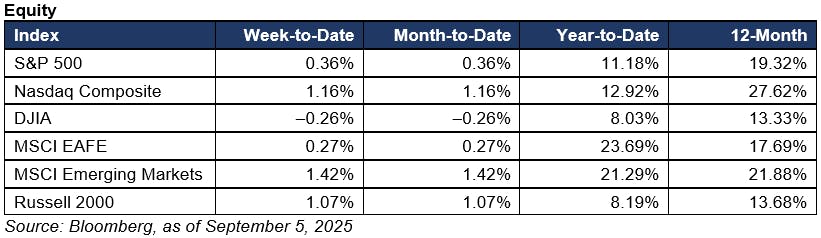
Equities were mixed in the holiday-shortened week, with the S&P 500 and Nasdaq Composite rising as the Dow Jones slipped. Tech outperformed; Alphabet and Apple rallied on a favorable antitrust ruling, lifting the Nasdaq more than 1 percent. Small-caps also advanced, reflecting rate-cut sensitivity. Technology services, health services, and non-energy minerals outperformed, whereas energy, utilities, and industrial services lagged. Labor market data disappointed, with nonfarm payrolls adding only 22,000 jobs, fueling hopes that the Fed will ease rates. Sentiment improved midweek but growth concerns capped gains, leaving equities consolidating near record levels.
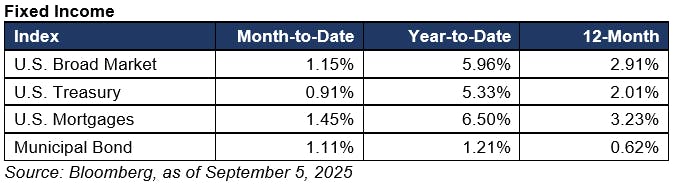
Treasuries swung sharply as shifting narratives around tariffs and labor data drove volatility. The 10-year yield climbed to 4.31 percent early in the week before retreating to 4.09 percent by Friday’s close, as weak nonfarm payrolls, softer ADP hiring, and higher jobless claims fueled demand for duration. Traders boosted bets on September easing, with futures implying an 86 percent probability of a quarter-point rate cut and a 14 percent chance of a half-point reduction. Although front-end yields were more stable, the curve flattened as long rates retraced. Credit spreads held firm, underscoring resilient risk appetite despite economic slowdown concerns and ongoing tariff uncertainty.
The Takeaway
· Equities were mixed, with the S&P 500 and Nasdaq rising as the Dow slipped; tech outperformed on an antitrust ruling, small-caps gained, and weak jobs data fueled hopes for a rate cut.
· Treasuries rallied late as payroll softness and higher jobless claims drove demand. Ten-year yields retreated, and September easing odds strengthened.
Looking Ahead
Data this week will spotlight small business sentiment, inflation trends, and consumer confidence, offering insights into the growth outlook and potential policy considerations.
· The week kicks off Tuesday with the NFIB Small Business Optimism Index for August, which has improved since April’s lows but remains below late-2024 levels.
· On Wednesday, the Producer Price Index for August is expected to increase at a more modest pace after surging in July.
· On Thursday, the Consumer Price Index for August is projected to show that headline inflation has accelerated modestly.
· We’ll wrap the week Friday with the preliminary University of Michigan consumer sentiment survey for September, which is expected to show little change.
Disclosures: This material is intended for informational/educational purposes only and should not be construed as investment advice, a solicitation, or a recommendation to buy or sell any security or investment product. Diversification does not assure a profit or protect against loss in declining markets, and diversification cannot guarantee that any objective or goal will be achieved. Please contact your financial professional for more information specific to your situation.
Bonds are subject to availability and market conditions; some have call features that may affect income. Bond prices and yields are inversely related: when the price goes up, the yield goes down, and vice versa. Market risk is a consideration if sold or redeemed prior to maturity.
Certain sections of this commentary contain forward-looking statements that are based on our reasonable expectations, estimates, projections, and assumptions. Forward-looking statements are not guarantees of future performance and involve certain risks and uncertainties, which are difficult to predict. All indices are unmanaged and are not available for direct investment by the public. Past performance is not indicative of future results. The S&P 500 is based on the average performance of the 500 industrial stocks monitored by Standard & Poor’s. The Nasdaq Composite Index measures the performance of all issues listed in the Nasdaq Stock Market, except for rights, warrants, units, and convertible debentures. The Dow Jones Industrial Average is computed by summing the prices of the stocks of 30 large companies and then dividing that total by an adjusted value, one which has been adjusted over the years to account for the effects of stock splits on the prices of the 30 companies. Dividends are reinvested to reflect the actual performance of the underlying securities. The MSCI EAFE Index is a float-adjusted market capitalization index designed to measure developed market equity performance, excluding the U.S. and Canada. The MSCI Emerging Markets Index is a market capitalization-weighted index composed of companies representative of the market structure of 26 emerging market countries in Europe, Latin America, and the Pacific Basin. The Russell 2000® Index measures the performance of the 2,000 smallest companies in the Russell 3000® Index. The Bloomberg US Aggregate Bond Index is an unmanaged market value-weighted performance benchmark for investment-grade fixed-rate debt issues, including government, corporate, asset-backed, and mortgage-backed securities with maturities of at least one year. The U.S. Treasury Index is based on the auctions of U.S. Treasury bills, or on the U.S. Treasury’s daily yield curve. The Bloomberg US Mortgage Backed Securities (MBS) Index is an unmanaged market value-weighted index of 15- and 30-year fixed-rate securities backed by mortgage pools of the Government National Mortgage Association (GNMA), Federal National Mortgage Association (Fannie Mae), and the Federal Home Loan Mortgage Corporation (FHLMC), and balloon mortgages with fixed-rate coupons. The Bloomberg US Municipal Index includes investment-grade, tax-exempt, and fixed-rate bonds with long-term maturities (greater than 2 years) selected from issues larger than $50 million. One basis point is equal to 1/100th of 1 percent, or 0.01 percent. One basis point (bp) is equal to 1/100th of 1 percent, or 0.01 percent.
###
Securities and advisory services offered through Commonwealth Financial Network®, Member FINRA/SIPC, a Registered Investment Adviser. Fixed insurance products and services are separate from and not offered through Commonwealth Financial Network®.
Authored by the Investment Research team at Commonwealth Financial Network®.
© 2025 Commonwealth Financial Network®