Market Update—Week of October 20, 2025
Market Update—Week of October 20, 2025
Presented by Zachary R. Sturdy
---
U.S. equities moved higher last week, rebounding from the trade tension‒induced sell-off the previous week. Semiconductors, credit cards, apparel, airlines, and restaurants helped lead markets higher last week. This was offset by a sell-off in some of the regional banks, which noted some areas of softness as well as the impact of some recent bankruptcies. Treasuries saw the 2-year yield hit a 3-year low, while the 10-year fell below 4 percent. How long the market continues to ignore the government shutdown remains to be seen.
Quick Hits
1. Beyond the headlines: A positive consumer backdrop covers up some of the small cracks that may be forming.
2. Report releases: The Fed’s Beige Book was released last week, showing a mixed economic picture.
3. Financial market data: Markets rebounded following softened comments from Trump that had raised trade tensions with China.
4. Looking ahead: The focus this week will center on the delayed release of inflation data just prior to the Fed’s October meeting.
Beyond the Headlines— Uncertainty Remains, but the Consumer Continues to Provide a Solid Backdrop
As the government shutdown reaches day 20, getting macro data continues to be a challenge, but we are able to get a read on consumers through several of the major banks and credit card companies that reported last week. Most of the major banks that reported noted that U.S. consumers, who drive a majority of the U.S. economy, continue to spend, as do businesses. Despite data delays, retail spending is up 6.2 percent in the third quarter. It is still heavily driven by the higher-income consumer, which continues to see growth. Still, the lower-income consumer has been resilient as well. After seeing a divergence in spending patterns in 2024, nearly all segments are seeing spending growth in 2025.
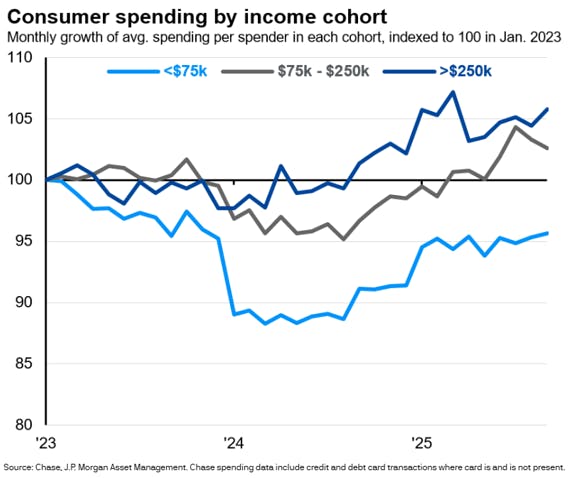
However, the results from some regional banks noted areas of softness in the economy that led to a
sell-off in related stocks last week. Several of the banks wrote off bad loans to commercial customers and prompted concern among investors that there could be more to come. A few large defaults happened last week, including Tricolor Holdings, a subprime auto dealer. Despite J.P. Morgan CEO Jamie Dimon’s comments that “when you see one cockroach, there are probably more,” the overall banking system is still showing strength. Banks and credit card issuers that have been focused on the higher-end consumer haven’t seen many cracks in their consumer base.
Another CEO, Ted Pick of Morgan Stanley, had an excellent comment on the earnings call, noting that “macro uncertainty and enormous opportunity uncomfortably coexist.” This continues to be the story that investors have to navigate, with the potential of AI, while also dealing with an uncertain picture consisting of softening employment, inflation that remains sticky, possible tariff impacts, and a market that is priced at valuations that were reached during Covid when rates were near zero. This is why we continue to see somewhat skittish markets when bad news comes out—as we did two weeks ago amid increased trade tensions with China—and within certain sectors or industries, as we saw in this past week’s sell-off in regional banks.
Given how markets are priced today, it’s important to keep an eye on the risks in your portfolio and how it’s allocated, while not losing sight of the overall positive backdrop in the economy.
Report Releases— October 13–17, 2025
Fed Beige Book– October (Wednesday)
- The Fed’s Beige Book was released last week, noting some concerns over softening labor and higher prices. Still, they noted that on balance, they’re seeing slight to modest growth.
National Association of Home Builders (NAHB) Housing Market Index: October (Thursday)
Home builder confidence improved by more than expected in October, bringing the index to a
six-month high.
- Expected/prior month NAHB Housing Market Index: 33/32
- Actual NAHB Housing Market Index: 37
The Takeaway
· With the government shutdown continuing to affect data collection, survey data from the Fed continues to show a mixed picture that will likely induce the Fed to continue cutting rates at a
slow pace.
Financial Market Data
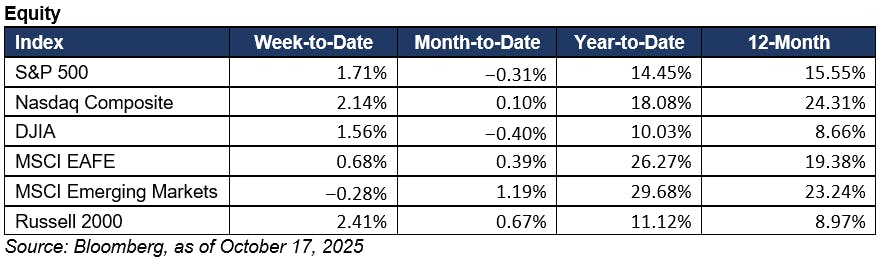
Equities rebounded from the previous week, after seeing a sell-off induced by trade tensions with China. After Trump softened his comments, areas impacted by trade, particularly semis, saw their stock price rise. There was a mixed picture in financials, as big banks rallied following earnings, while regional banks fell over credit concerns. Other outperformers included credit cards, apparel, airlines, restaurants, machinery, chemicals, and home builders. Underperformers included pharma, managed care, media, food, and software. Despite the positive results from the big banks, the financials sector was the worst performer due to both the regional banks and insurance weakness.
Fixed Income
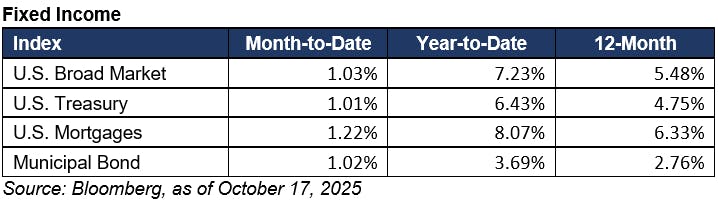
Treasury yields saw the 2-year yield reach a 3-year low at 3.42 percent last week, while the curve saw some overall steepening, with longer-term yields falling less than shorter-term yields. Still, the 10-year yield fell below 4 percent for the first time since it briefly touched that level back in April around Liberation Day. Falling yields were helped by some softness noted in the Fed’s Beige Book.
The Takeaway
· Markets continue to climb higher after Trump softened his comments that raised trade tensions with China. Still this outlines the risks inherent in a market that is trading at valuations that were last seen during Covid, when rates were near zero.
· Yields continue to fall as softer data prices in further Fed cuts.
Looking Ahead
This week will center on key inflation and housing data.
· On Thursday Existing Home Sales—September will be released. The pace of existing home sales is set to improve in September after slowing in August.
· The Consumer Price Index—September is expected to be released on Friday. The Bureau of Labor Statistics (BLS) is releasing a delayed report on September inflation despite the government shutdown. This will be a widely anticipated release, given the timing is the week before the October Fed meeting.
Disclosures: This material is intended for informational/educational purposes only and should not be construed as investment advice, a solicitation, or a recommendation to buy or sell any security or investment product. Please contact your financial professional for more information specific to your situation.
Certain sections of this commentary contain forward-looking statements that are based on our reasonable expectations, estimates, projections, and assumptions. Forward-looking statements are not guarantees of future performance and involve certain risks and uncertainties, which are difficult to predict. All indices are unmanaged and are not available for direct investment by the public. Past performance is not indicative of future results. The S&P 500 is based on the average performance of the 500 industrial stocks monitored by Standard & Poor’s. The Nasdaq Composite Index measures the performance of all issues listed in the Nasdaq Stock Market, except for rights, warrants, units, and convertible debentures. The Dow Jones Industrial Average is computed by summing the prices of the stocks of 30 large companies and then dividing that total by an adjusted value, one which has been adjusted over the years to account for the effects of stock splits on the prices of the 30 companies. Dividends are reinvested to reflect the actual performance of the underlying securities. The MSCI EAFE Index is a float-adjusted market capitalization index designed to measure developed market equity performance, excluding the U.S. and Canada. The MSCI Emerging Markets Index is a market capitalization-weighted index composed of companies representative of the market structure of 26 emerging market countries in Europe, Latin America, and the Pacific Basin. The Russell 2000® Index measures the performance of the 2,000 smallest companies in the Russell 3000® Index. The Bloomberg US Aggregate Bond Index is an unmanaged market value-weighted performance benchmark for investment-grade fixed-rate debt issues, including government, corporate, asset-backed, and mortgage-backed securities with maturities of at least one year. The U.S. Treasury Index is based on the auctions of U.S. Treasury bills, or on the U.S. Treasury’s daily yield curve. The Bloomberg US Mortgage Backed Securities (MBS) Index is an unmanaged market value-weighted index of 15- and 30-year fixed-rate securities backed by mortgage pools of the Government National Mortgage Association (GNMA), Federal National Mortgage Association (Fannie Mae), and the Federal Home Loan Mortgage Corporation (FHLMC), and balloon mortgages with fixed-rate coupons. The Bloomberg US Municipal Index includes investment-grade, tax-exempt, and fixed-rate bonds with long-term maturities (greater than 2 years) selected from issues larger than $50 million. One basis point is equal to 1/100th of 1 percent, or 0.01 percent. One basis point (bp) is equal to 1/100th of 1 percent, or 0.01 percent.
###
Zachary Sturdy is located at 307 S Front St, Ste 107 Marquette, MI 49855 and can be reached at (906)226-6056. Securities and advisory services offered through Commonwealth Financial Network®, Member FINRA/SIPC, a Registered Investment Adviser. Fixed insurance products and services are separate from and not offered through Commonwealth Financial Network®.
Authored by the Investment Research team at Commonwealth Financial Network®.
© 2025 Commonwealth Financial Network®